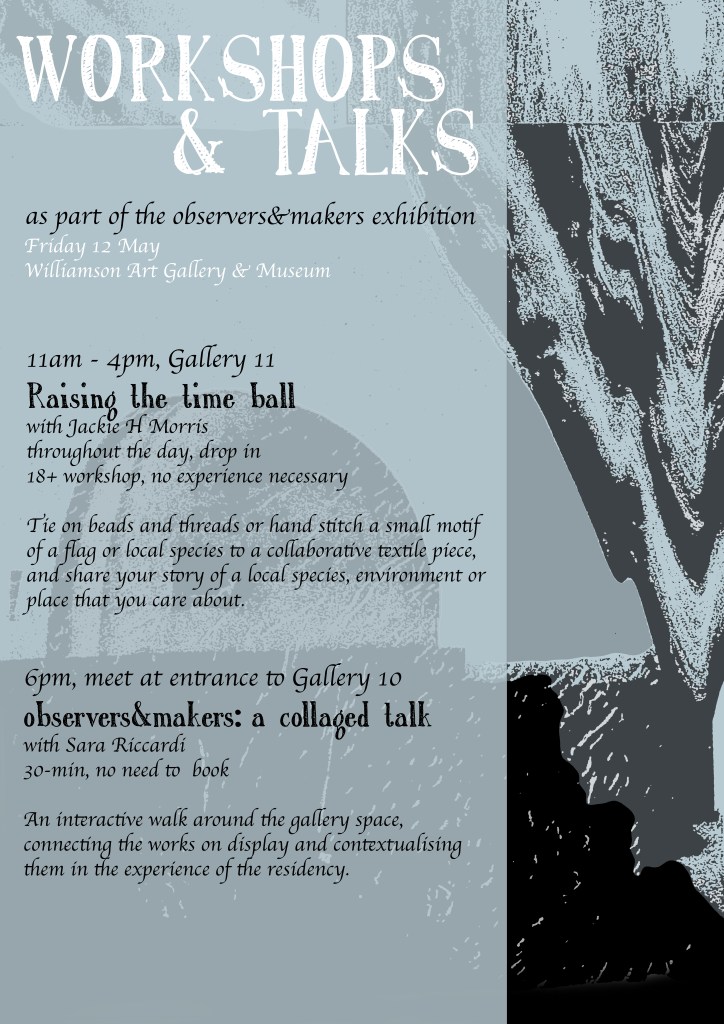
This workshop idea developed after my residency/retreat at Bidston Observatory in February 2023 with ten other research colleagues. Here is the advertisement for the workshop, the poster designed by Alice Thickett.
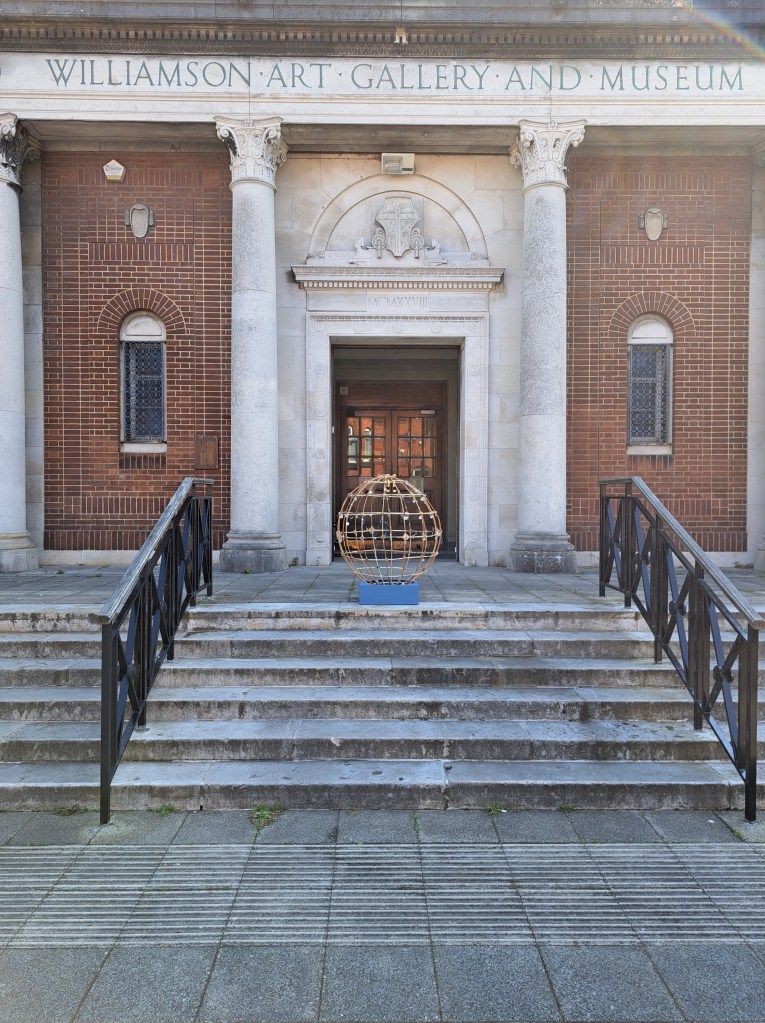
On 12th May 2023 we had a one day pop up exhibition kindly hosted by Williamson Art Gallery and Museum following our residency at Bidston to show our research work and outcomes. Our thanks go to The Williamson team of Kirsty, Niall, Julia and Sam for all their help in accomodating and advertising our events. I planned to run the workshop all day at the Williamson. I also wanted the opportunity to develop the themes of ecology and environment pertinent to my main research re-engaging with folkore in rural place. My thanks also go to Stewart Kelly, fellow stitching researcher who spontaneously helped me with the workshop throughout and had suggestions of other local textile groups I could contact to take part.
Here is my inspiration and aims for the ‘Raising the Time ball’ workshop

Keywords: threads, beads, knots, memory devices, history, raising awareness, local ecology
Outline of workshop: This creative participatory workshop is inspired by a stay at Bidston Observatory, a visit to Michael Brennand-Wood’s recent exhibition The Encirclement of Space at Williamson Art Gallery & Museum, and the colours of the Della Robia Ceramics collection at the Museum.
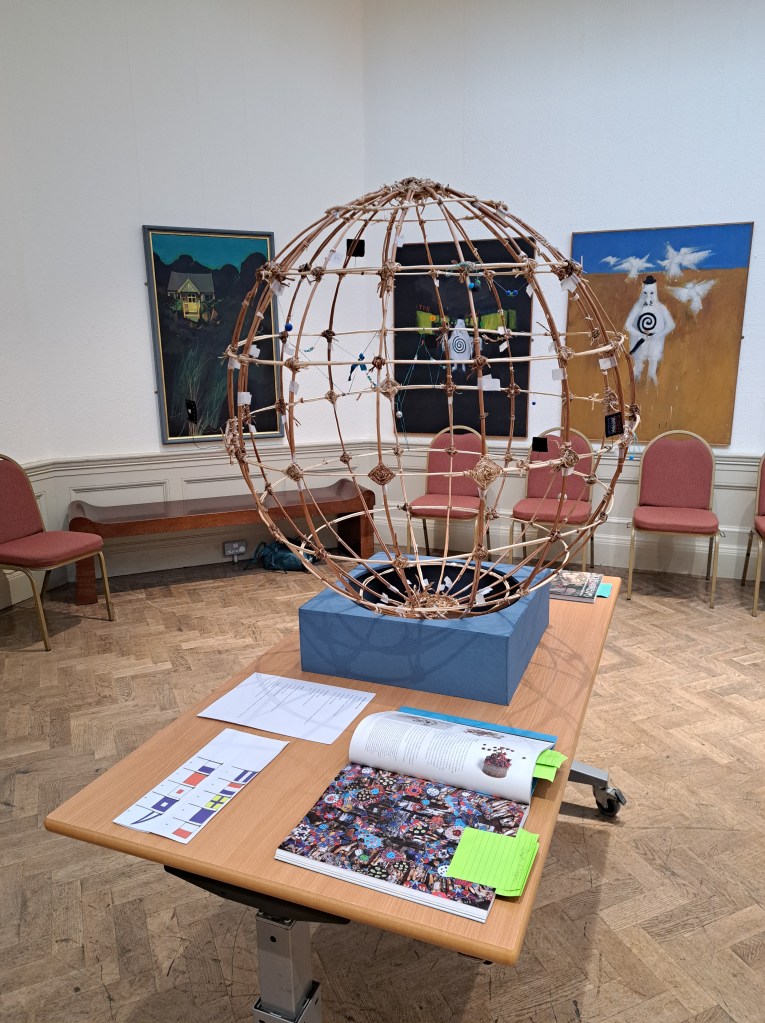
Together we will recreate the Time ball that was on the roof of the Liverpool Observatory at Waterloo Dock from 1844 to around 1866, before the Observatory was rebuilt at Bidston. This time ball was a large wicker sphere hoisted up a mast just before 1 pm and allowed to fall at precisely 1 pm signalling accurate time as observed from the stars with a transit telescope and allowing all in view of it to reset their watches.
A new local system of communication between ships and land was developed and used at Bidston Signal tower around 1795, consisting of ten different flags representing the numbers 0-9. As they approached around Anglesey, ships hoisted three flags relating to their number and their impending arrival was noted and passed on by land to their merchant owner at Liverpool. This method supplemented a previously used ball and flag system and lasted until the adoption of semaphore methods around 1816.
Today with the approach of ecological catastrophe, this workshop is raising the time ball once more to signal that action is needed. Together we will be using threads, beads and stitching to decorate a large wicker time ball, and stitching small motifs of the flags and threatened local species to add on to the time ball. Whilst we decorate and/or stitching we will have stories about astronomy such as time keeping using the stars and measuring longitude, and about local ecology.
Threads, stitch, beads and knots have longed been used by humans to capture and recall memories. The threads and colours used will in the main reflect the blues and greens of the Della Robia ceramics and our view of the night sky.
You are invited to drop into the workshop to listen, tie on beads and threads or hand stitch a small motif of a flag or local species and / or to share your story of a local species or environment or place that you care about. No experience of stitching or storytelling is necessary, age 18 upwards.
Workshop set up
In the weeks leading up to the workshop I raided my bookshelf for nature books, found a map of the area in a charity shop and trawled through car boot stalls for beads and threads. I had to buy threads the colour of the semaphore flags, but on a visit to Manchester Metropolitan University’s Make Store to get threads and black trafalgar wool fabric for the flags, found that the Fashion Institute had just deposited a load of Trafalgar Wool in the free bin, so I was lucky! I also found an example of flag embroidery at the car boot stitched as a souvenir of Egypt in 1916.


I had ordered some willow as soon as I had had the idea for the workshop upon reading of the original willow time ball on Liverpool’s Observatory on Waterloo Dock. I wanted to make it as big as I could but still be able to transport it in the car. I referred to a book to remind myself how to form the ‘god knot’, but otherwise its construction was experimental. I did not manage to achieve an exact spherical structure despite best efforts, but hopefully the added flags will correct this visually.


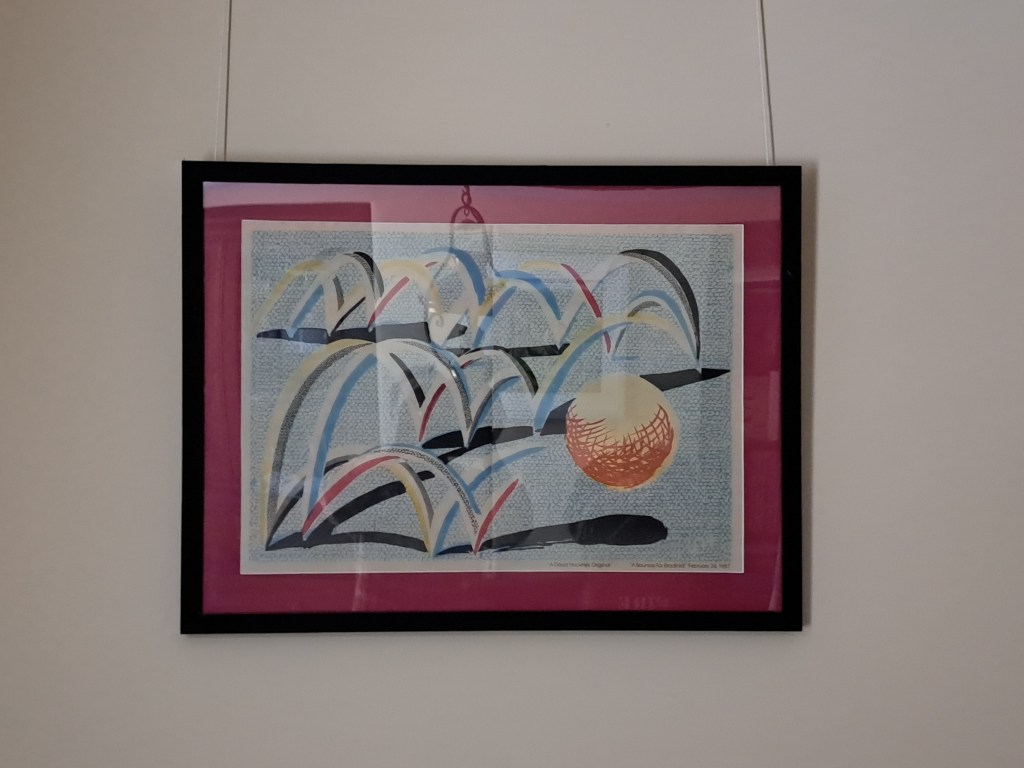
After its construction I spied David Hockney’s newspaper print ‘Bounce for Bradford’ (1987) on my bedroom wall and wonder if I had been influenced by the spherical ball. I decided a good title could be ‘A bounce for Birkenhead’ in homage to Hockney’s intent for Bradford’s recovery and wanting everyone to be able to own a piece of art, only to have the dealers buy up all the newspapers. This metaphorical bounce would be for the Wirral’s wildlife and habitats.
Wirral Habitats and Species
Hilary Ash, Honorary Conservation Officer of Wirral Wildlife, The Wirral Group of Cheshire Wildlife Trust kindly provided me with a list of site names and endangered species. I hope that we can look them up in my selection of nature books and that embroideries of them, their names or place names might be attempted.
Endangered species in Wirral: natterjack toad, great crested newt. Bats such as Daubenton, pipistrelles, brown long-eared. Water vole. Grayling butterfly, white-letter hairstreak butterfly. Various rare bees on the sand dunes such as Vernal Mining Bee (Colletes cunicularius). Plants include Isle-of-Man Cabbage, Equisetum x meridionale (Southern horsetail), Dyers Greenweed, Sanicle.
Habitats: lowland heathland (Thurstaston Common SSSI and Heswall Dales SSSI), sand dunes and salt marsh (Red Rocks SSSI). Ancient woodland – Dibbinsdale SSSI.
Endangered species in Wirral: natterjack toad, great crested newt. Bats such as Daubenton, pipistrelles, brown long-eared. Water vole. Grayling butterfly, white-letter hairstreak butterfly. Various rare bees on the sand dunes such as Vernal Mining Bee (Colletes cunicularius). Plants include Isle-of-Man Cabbage, Equisetum x meridionale (Southern horsetail), Dyers Greenweed, Sanicle.
Habitats: lowland heathland (Thurstaston Common SSSI and Heswall Dales SSSI), sand dunes and salt marsh (Red Rocks SSSI). Ancient woodland – Dibbinsdale SSSI.
She says the coast is nearly all highly protected for wetland birds (wildfowl and waders), which winter here in their thousands. Search for Dee Estuary (SSSI, SAC, SPA and Ramsar site), Mersey Estuary, North Wirral Foreshore.
Some of the participants who dropped into the workshop and some of my retreat colleagues
On the day of the workshop itself, I was somewhat thwarted by the train strike and competing interests of Eurovision in Liverpool. The first visitor who tied on the first bead used to work at Bidston Observatory when it was owned by Proudman Oceanographic Laboratory, now based at University of Liverpool. He was visiting with his wife and grandaughter and assisted his grandaughter to tie on a bead too. His wife added one also. It was also his birthday and I felt so lucky as he was able to tell us history about Bidston Hill that we had not realised at all during our stay there, intriguing but quietly kept details. This means we will have to go back. A post retreat exhibition makes you realise all that you missed!


These visitors pictured below were keen to sew and got stuck straight in embroidering semaphore flags. My aim was for a densely layered aesthetic as inspired in Brennand-Wood’s art work. The flags were backed with another piece of Trafalgar wool fabric, sandwiching a twist of wire between, leaving a length sticking out to attach the flag to the wicker frame.


My colleagues Alice and José added webs of thread. Later José spent ages threading tiny turquoise beads onto a string to make a turquoise core for the Timeball; he said that this is important in ancient Mexican mythology, which he is researching.


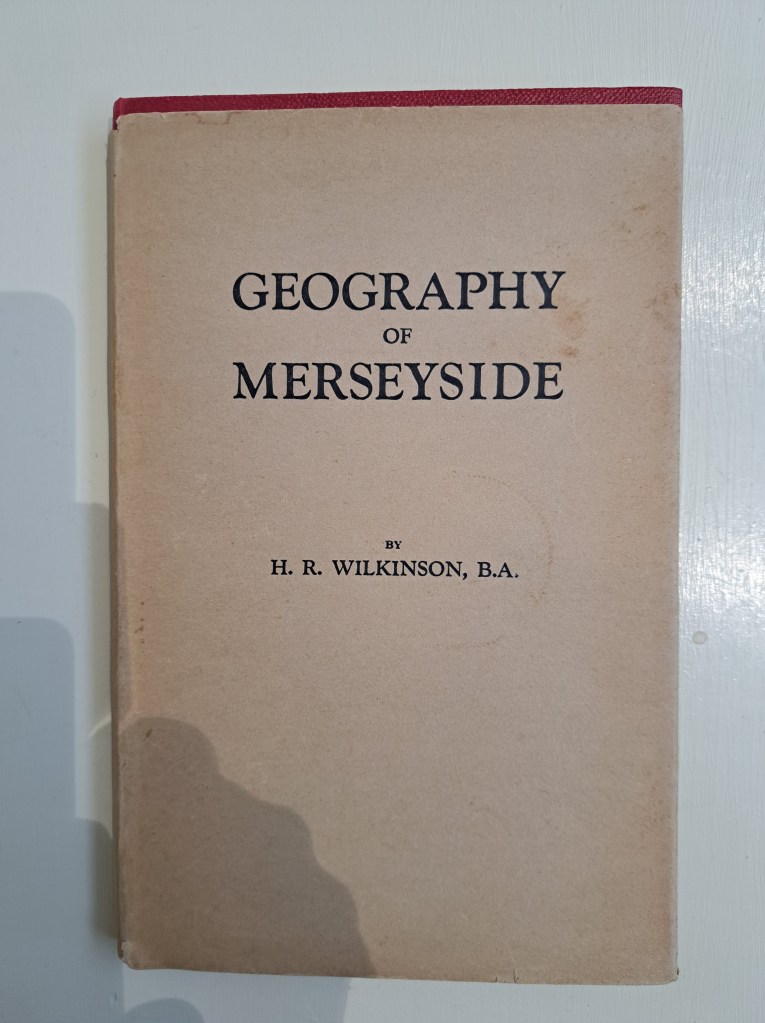
Moira arrived in the afternoon and enthused about the workshop, immediately thinking of many folks it could have appealed to. She volunteers at the Williamson and fetched some beautiful books about the geography of the area and the lie of the land.



As the late afternoon moves into our evening event, more of our residency collegues arrive, their journeys more complex due to the train strike. We sit round the table discussing work and then Sara presents her talk to us. It is an informal but wonderful catch up time, post retreat. There are a few visitors to the exhibition event but we all agree it has been a successful day. We wonder about repeating the exhibition in Manchester, perhaps showing this work but also how it develops. One option may be to show it at The Poetry Library.


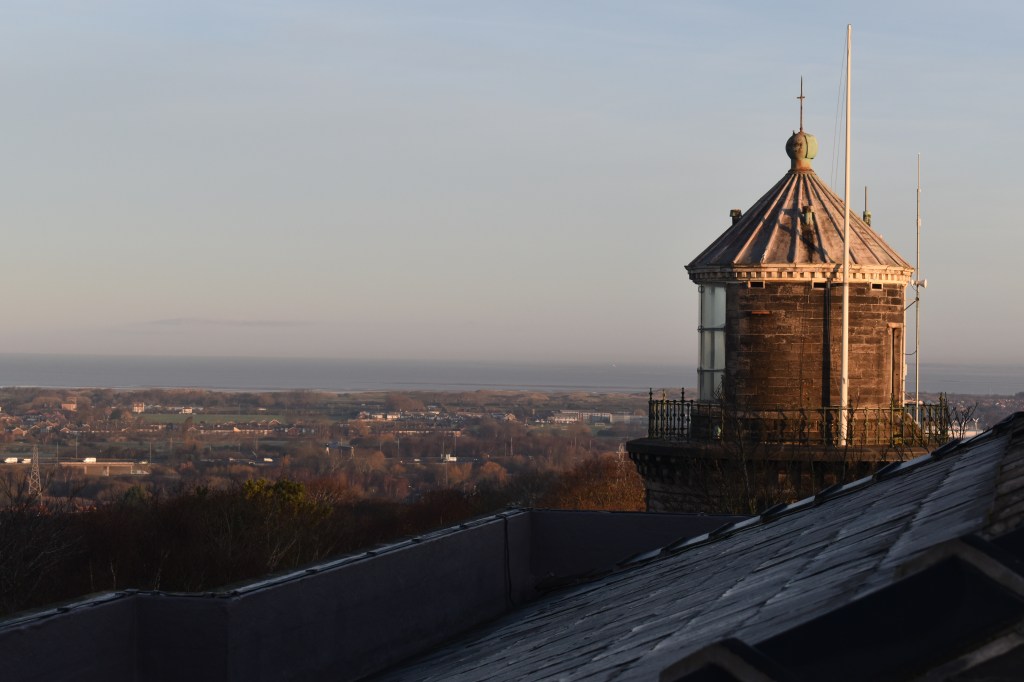
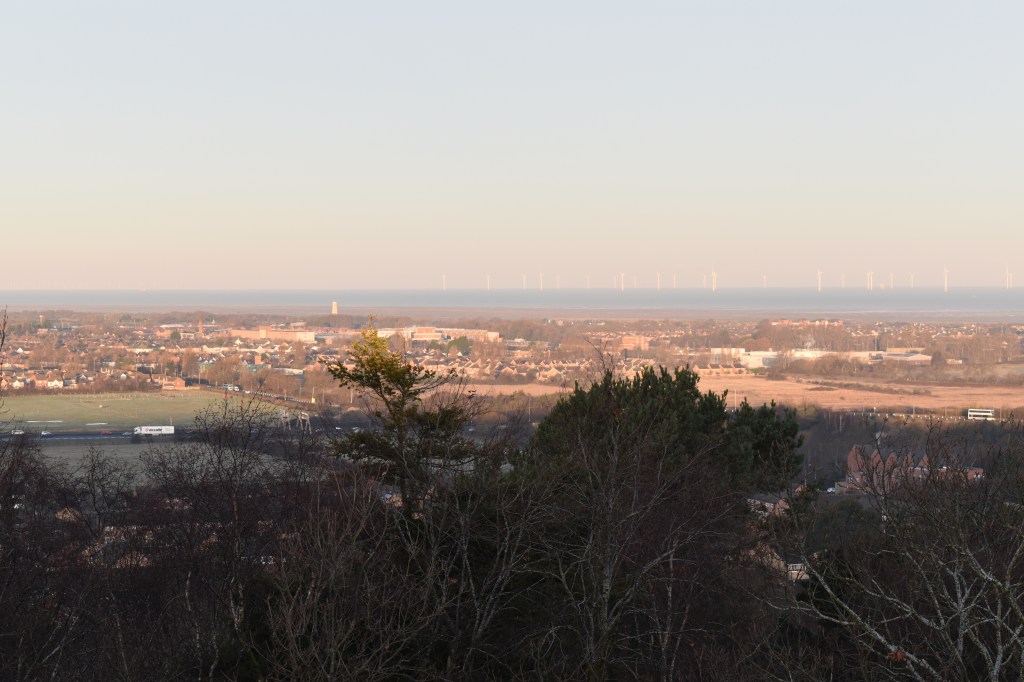
Landscapes viewed from Bidston Observatory

Links
Wirral Wildlife
Laura from Wirral Wildlife provided a list of Wirral species and habitats that they produced last year for the Wirral’s Wild 50 project, but said they aren’t necessarily endangered: https://www.wirralwildlife.org.uk/wirrals-wild-50-activity-sheets
Other local wildlife groups’ details can be found on the Links page of our website: https://www.wirralwildlife.org.uk/links and also the Wildlife Recording page: https://www.wirralwildlife.org.uk/wildlife-recording-in-wirral
Wirral Environmental Network
RSPB
Liverpool Astronomical Society
 The Lugg Embroideries