Thinking about borders – a creative workshop to stitch in solidarity with the people of Ukraine.
This is a creation of an art work in which we stitch together as we dwell on borders. It was launched as a collaboration with a colleague Libby Rous (MA Design – Textiles) as part of PAHC Symposium at Manchester Metropolitan University where we both study.
Libby Rous is an aspiring designer of knitted typography. She has experimented with the use of Sashiko (Japanese Embroidery) and Boro (Japanese patchwork) on reclaimed knitwear. Her designs mix humour with serious issues such as climate change, the UK’s hostile response to refugees and our reliance on fast fashion.
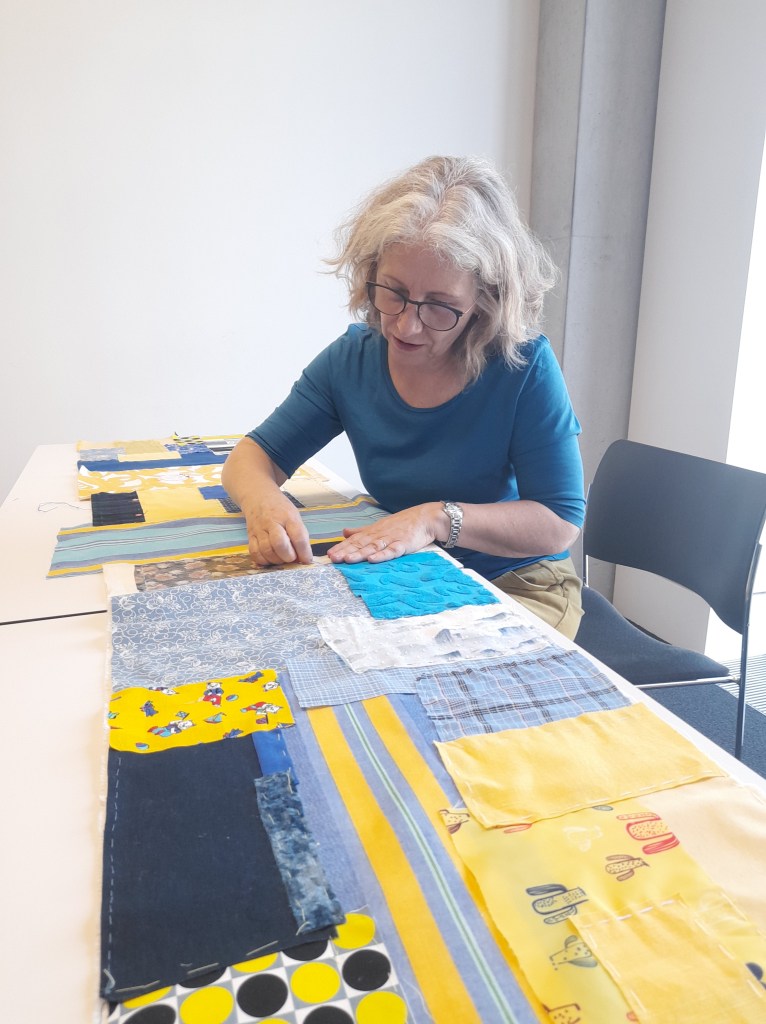
My approach has been directly influenced by The Lugg Embroideries project as during that we listening to poetry about the River Lugg and other readings whilst we stitched allowing contemplation of the subject. Rhythmic stitching and words allowed a freedom for thoughts to roam and focus.

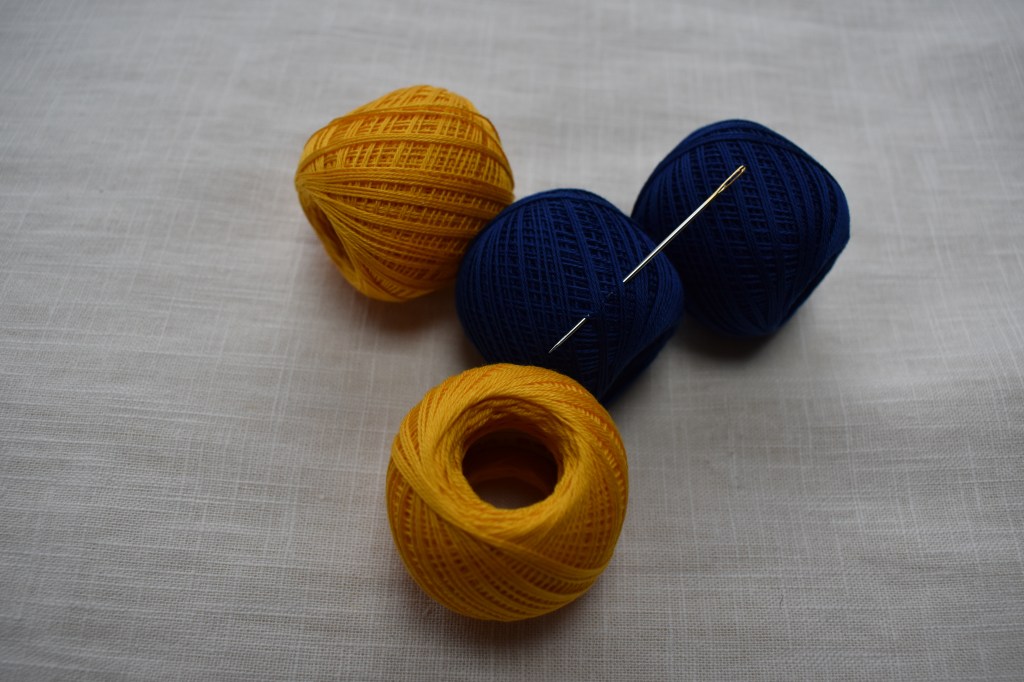
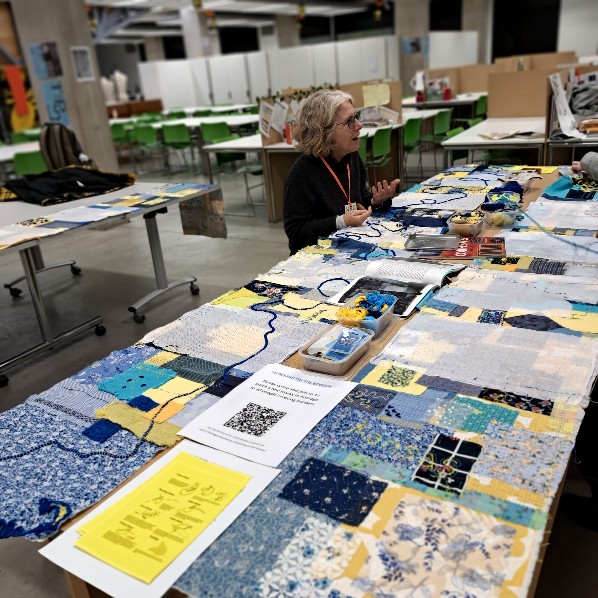
The invitation to the launch workshop on 19th May 2022: You are invited to join a workshop to stitch fragments of blue and yellow fabric to a long border strip using simple sashiko running stitch in the tradition of the ancient craft of Japanese boro (patchwork). We are working loosely to the colours of the Ukraine flag. All materials, needles, instructions, and assistance will be available but please bring along any personal patches of blue or yellow fabric or thread that you may like to add. Boro tends to be in rectangles or squares and can be very small. Additionally, or alternatively (if you are not a stitcher), you are invited to bring along a short piece of writing about thoughts of the border, your own or something you found. These can be read out whilst the stitchers stitch. The art piece will then travel over the next few months to various community centres in the country to be added to by local groups. A book will be available to document your contribution – this can be your name and any piece of writing you may wish to be shared with other groups as the piece travels.

Launch session – 19th May 2022
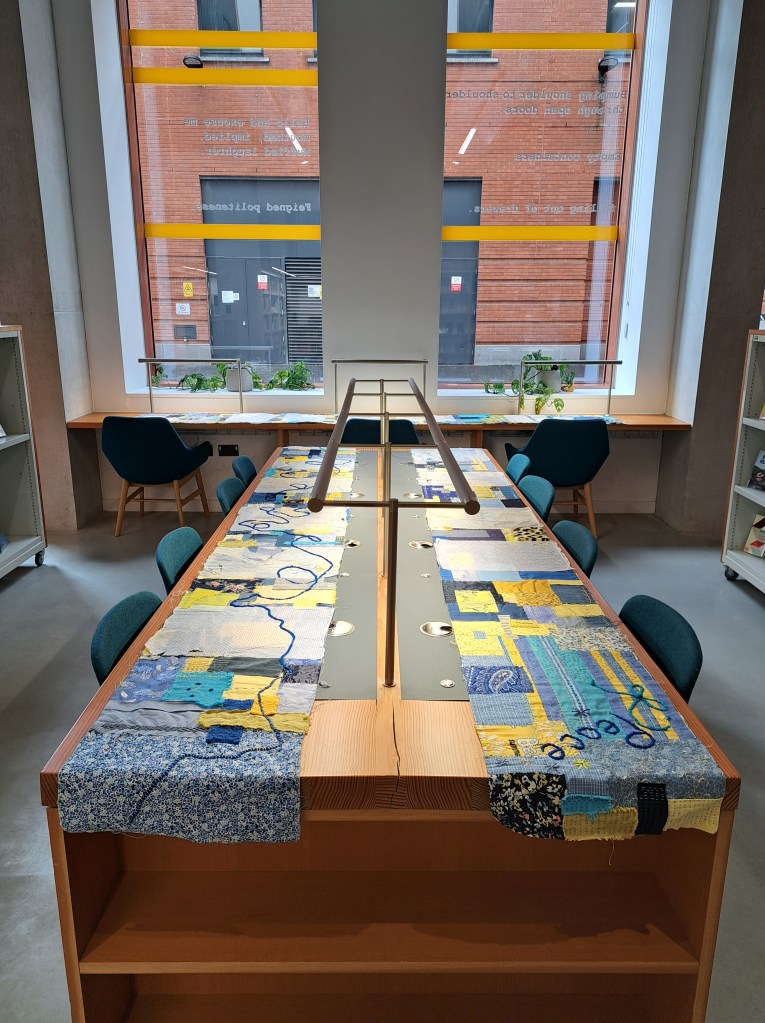
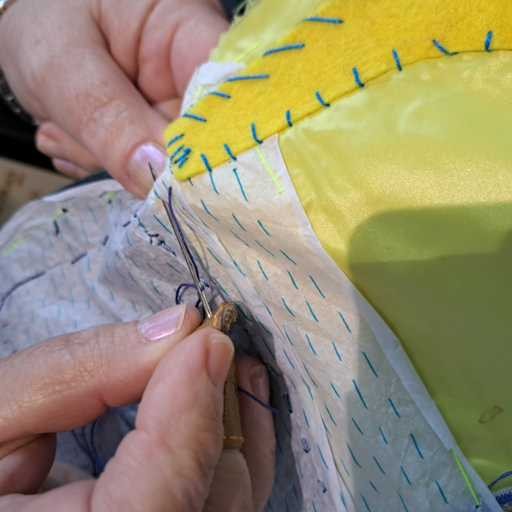
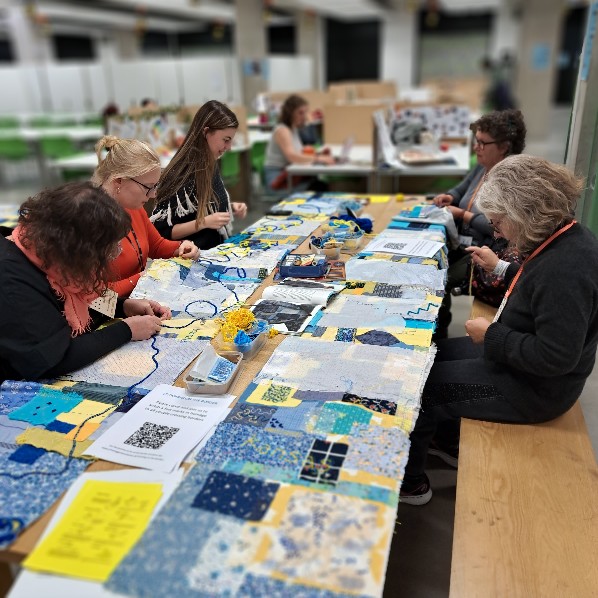
The first session was for one hour in a lunch break as part of the Symposium. We were thrilled that twenty-one people came to participate, at one point we had wondered if anyone would attend. The first task was to tack down the blue and yellow fabric snippets to the background pieces. We had divided the background into four, to be joined when entirely worked, so that it was easier for everyone to gather round. Each piece is 45 cm by 3.5 m. Some fabric pieces were donated from MMU’s Textiles Technician team who kindly helped me rummage through their cloth bins. Some threads, needles and pins came from the MMU Store. Prior to the workshop I had dyed some fabric pieces, also experimenting with dyeing with daffodil flowers.

Introduction to session:
The following reading from Ulrike Hanna Meinhof’s essay stresses the need to (re)create spaces of encounter between the diverse people of Europe. I hope in some small way our stitching groups also allow such encounters between participants. She talks of possibilities of ways of viewing Europe as a bounded Europe of borders, or a Europe of networks or one of neighbourhoods. Excerpt from Ulrike Hanna Meinhof’s (2014) ‘Images and Stories from the Borderlands’, Nordlit, 31, 25-47. Available at: https://eprints.soton.ac.uk/382636/.
Readings: Richard Shute read to us about borders whilst we stitched. Martin at MMU’s Poetry Library is also sourcing some border readings. At the bottom of this page are some audio clips of Richard’s readings which can be replayed at stitching groups where the border artwork travels next.

Documenting the border’s journey: The border will now travel to various groups to be added to over the next few months. As hand stitching is slow process there is no deadline to be reached, I think we will sense when it feels finished. It is hoped it will be presented in some form in a liminal space, such as an atrium or stairwell. There has been a suggestion that it could be on show in The Righton Building at Mancheter Metropolitan University, which is an old department store with a large open space, now used as a research hub. If it comes to your group, please do send us a photo, if stitchers give their consent to share their image publically, and any thoughts or extra readings on borders that you would like to add to this page.

Hereford Cathedral Broderers – 8th June 2022
Mary Roberts, one of the Lugg Embroiderers took the border to the Broderers on Weds 8th June and reports they had a lovely time patching and stitching. The six broderers are happy to share their image for the purposes of the project.

Hereford Textile Group – 9th June 2022
The next day Mary went to the Textile Group and reports “there were 12 of us to sit, chat and stitch…Everyone who did the project said they really enjoyed it. It was fun and relaxing and gave us time to catch up, especially at the Textile Group where a lot of us haven’t met for 2 years. I hope everyone else enjoys it as much as we did”.

Mary reported “Joan Ritchie read a poem which she had written herself. She read it out and impressed everyone – there were a few seconds of silence when she finished. I took a photo of the book she had written it in so hope you can read it. She is happy for you to use it if it is credited to her. Also everyone doesn’t mind you using the photos for the purpose of the project”.
Thank you Joan so much for sharing your poem, it is evocative of experiences from the past and sadly our present. It captures the courage required to manage the fears and horrors, and I think a situation that is one step away from us all with a sudden change in circumstances. For me its also a reminder of the precariousness and sacrifices of the lives of my grandparents during the Second World War.

Sewing Circle – Research Hub Day at International Anthony Burgess Foundation – 20th June 2022
Professor Fiona Hackney kindly invited us to bring the Border project for a lunchtime workshop at her event for Fashion and Textile academics examining standards and processes of high quality research and grant applications. The venue was a very interesting building, a palimsest of layers in its stone and brickwork and downstairs there was an exhibtion of typewriters from its archive of writer, novelist, poet, screenwriter, broadcaster and composer Anthony Burgess. Even the walk from Oxford Road station was interesting with the typography on the old industrial buildings. Burgess experienced living in several countries so having the Borders project worked on here felt special. The theme of his famous novel Clockwork Orange reflects human actions and morality.



Eight people added to the border and more enjoyed Richard’s readings about borders over lunch.


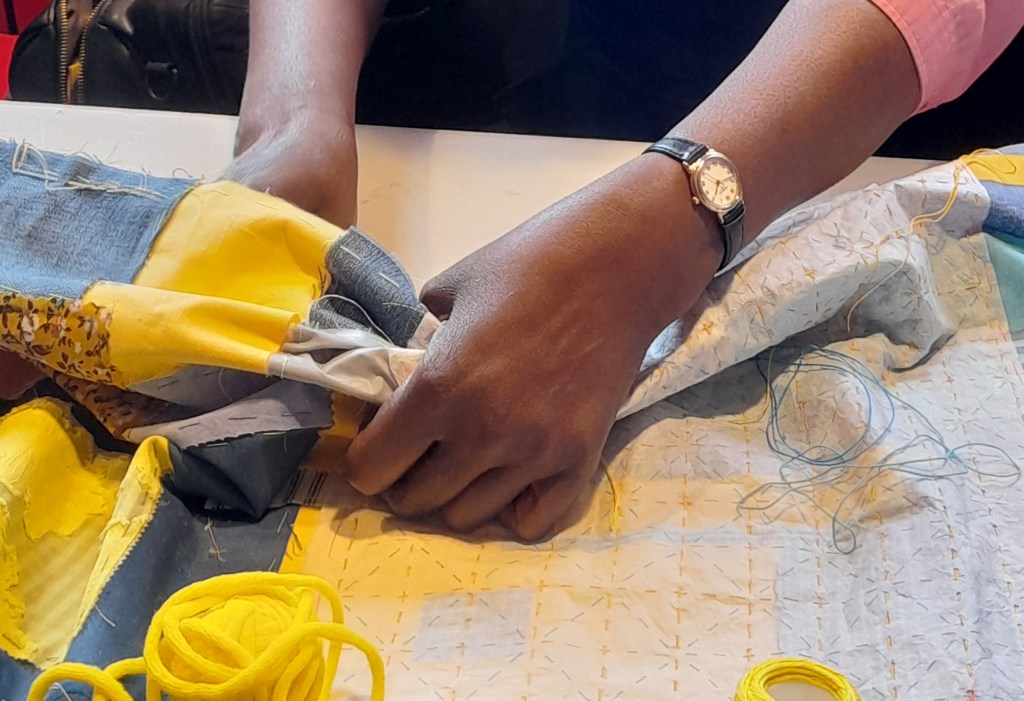

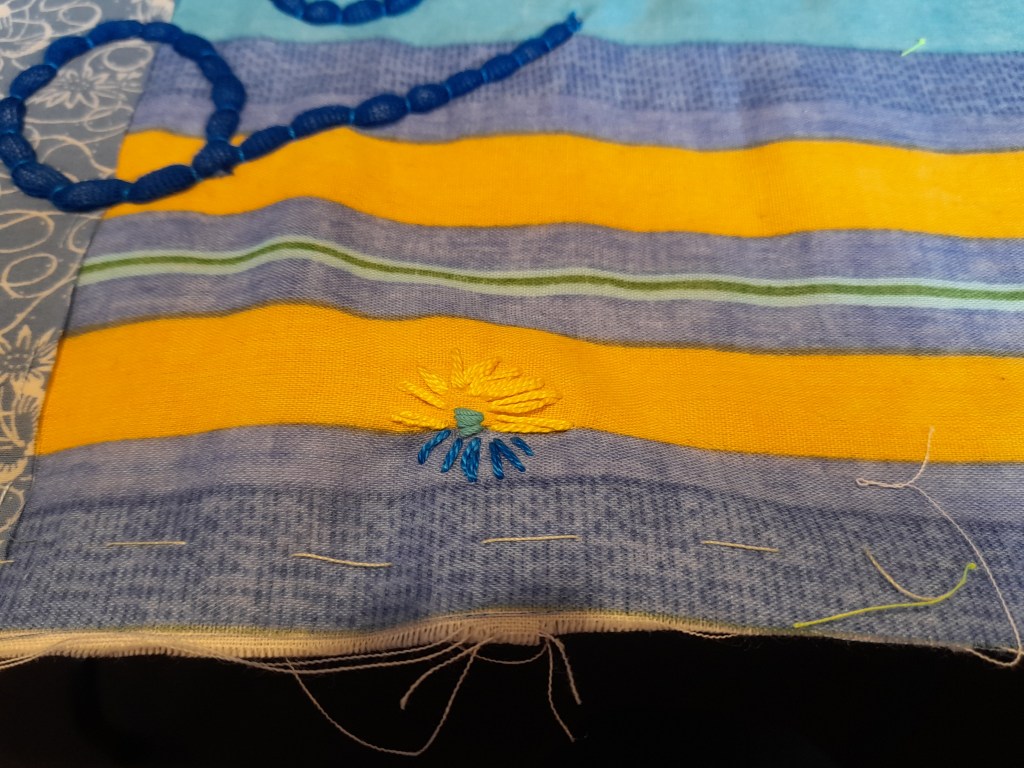
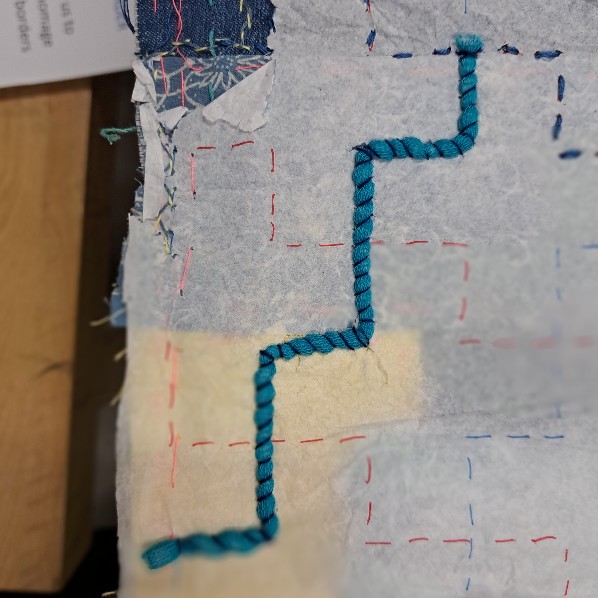
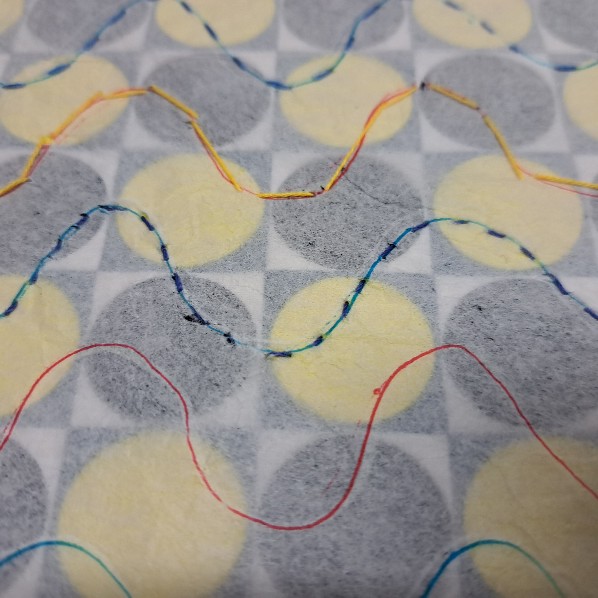
A reflective moment was when a participant explained she had deliberately stitched an open chain stitch. This gesture perhaps symbolising hopes for open borders and freedom. At this moment textile artist Alice Kettle’s (2022) recent inspiring words came to mind ‘Thread is a way you can transform the world and you have power’.
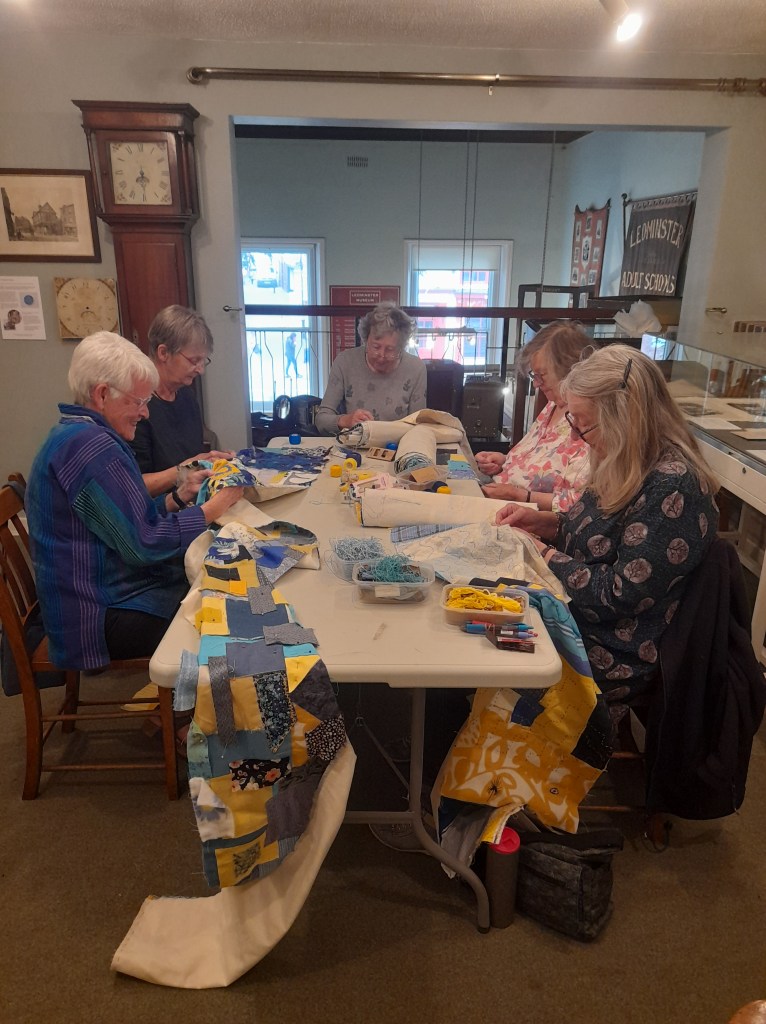
Leominster Museum – 28th June 2022
Morning session:

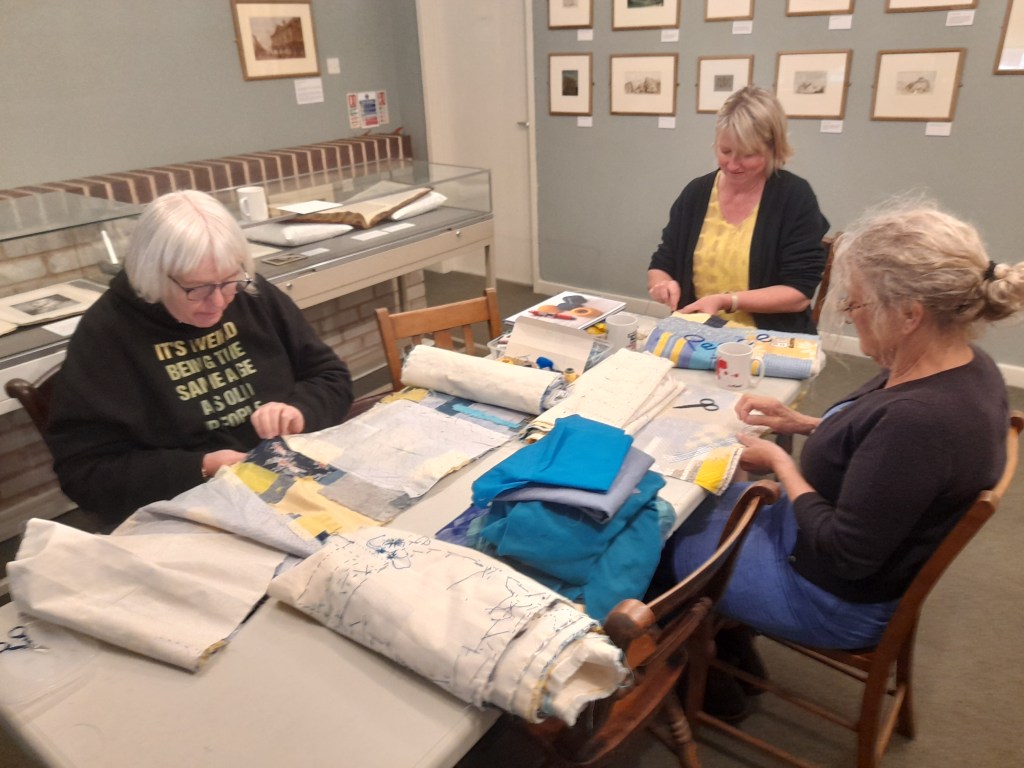
Afternoon session:

December 2022 update:
The border still needs a lot more stitching so I am looking for groups to take one of the four strips each to work on. Manchester Metropolitan University are keen to have it displayed in the open space in the Righton Building on campus. I might be able to organise a regular drop in session at the Univeristy for a stitch and discussion session in the New Year. If your group would like to work on one of the border pieces, please do get in touch with me, I am Herefordshire based. jacqueline.morris@stu.mmu.ac.uk
Sharon Hall Shipp’s additions to the border: 1st April 2023
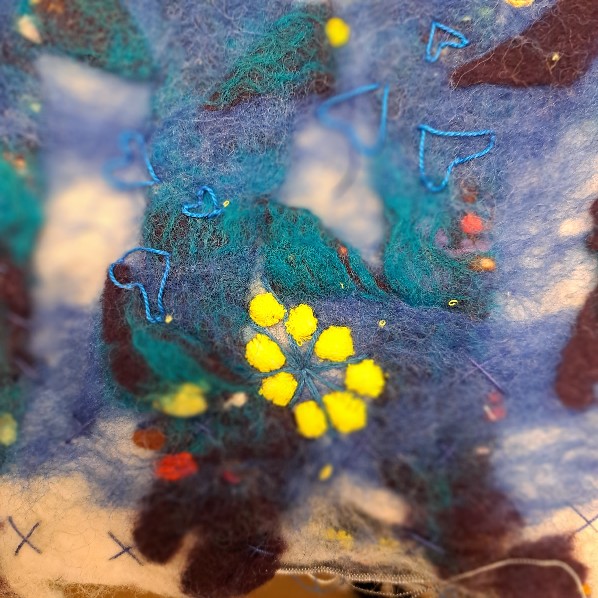
Two folks volunteered to take a border piece to work on from December 2022. I dropped it off with collage artist Sharon, meeting on the Welsh:English border which felt appropriate! In April I borowed it back again in preparation for the five planned workshops starting at Manchester Poetry Library. Sharon has added a fabulous river, these often form borders themselves. She hopes it is stiched over in the upcoming groups. She thinks that she feels the whole piece needs a lot more stitching into to make it rich, a sentiment I entirely agree with!

Leominster Quilters – Monland Village Hall, 1st March 2023
leominster Quilters invited me to talk about my research and upcoming participatory textile projects. There was not an overhead projector in the village hall so I wasn’t able to supplement my talk with visual interest. I decided to take the border along so that the Quilters could add to it if they wished whilst I talked. I learnt that Quilters usually work on machines at home on their own, perhaps listening to the radio or podcast, so stitching together and by hand was a different experience. I am grateful for the additions that they made and had some lovely conversations with individuals there. Thank you for asking me to come along.
This was my first visit to Monkland but I knew that it was here that folklore collector Ella Mary Leather, whose work my research pivots around, together with Ralph Vaugan Williams visited Monkland in September 1912. They listened to Gypsy tenor Alfred Price Jones sing his version of The Unquiet Grave and Vaughan Williams later described it as one of his “most memorable musical impressions“. I learnt from a participant that the Reverend Sir Henry Williams Baker (1821-1877) of Monkland Priory Church compiled the book of Classic Hymms Ancient and Modern, contributing hymms, tunes and translations, the book selling 60 million copies. One famous hymm he wrote the words to accompany an ancient Irish tune is ‘The King of Love my Shepherd is’. Monkland village has musical roots!


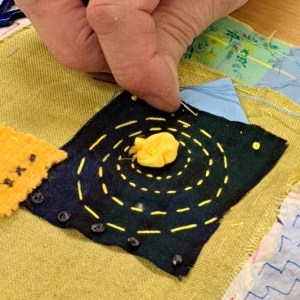


Manchester Poetry Library – 5th April 2023
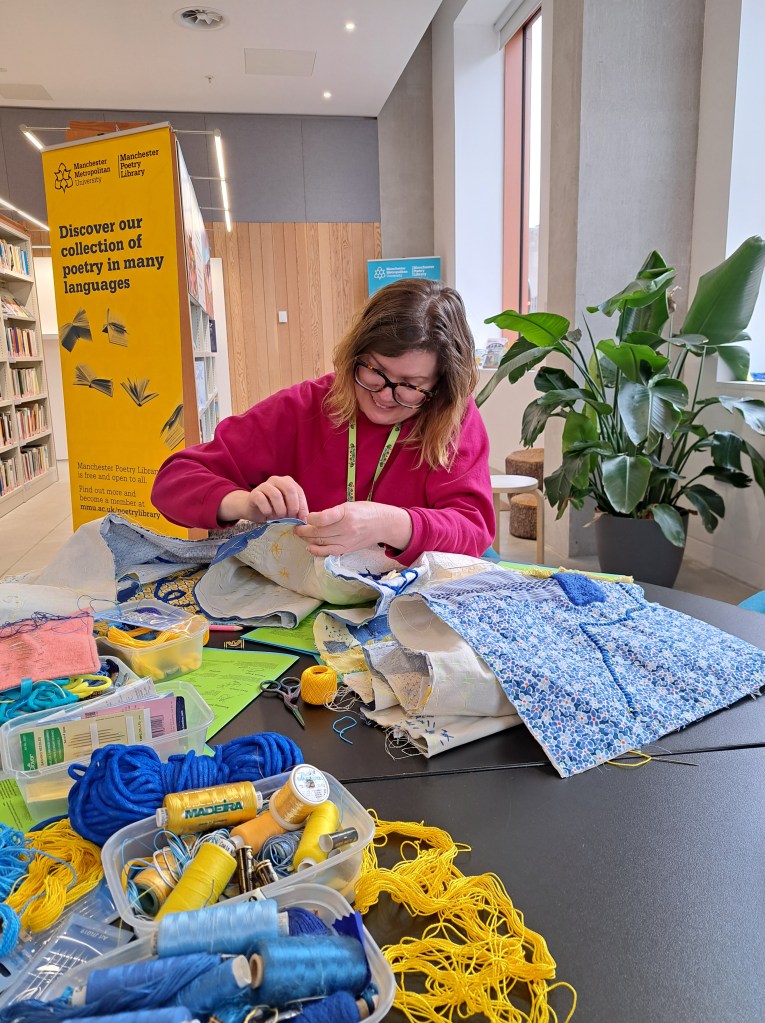
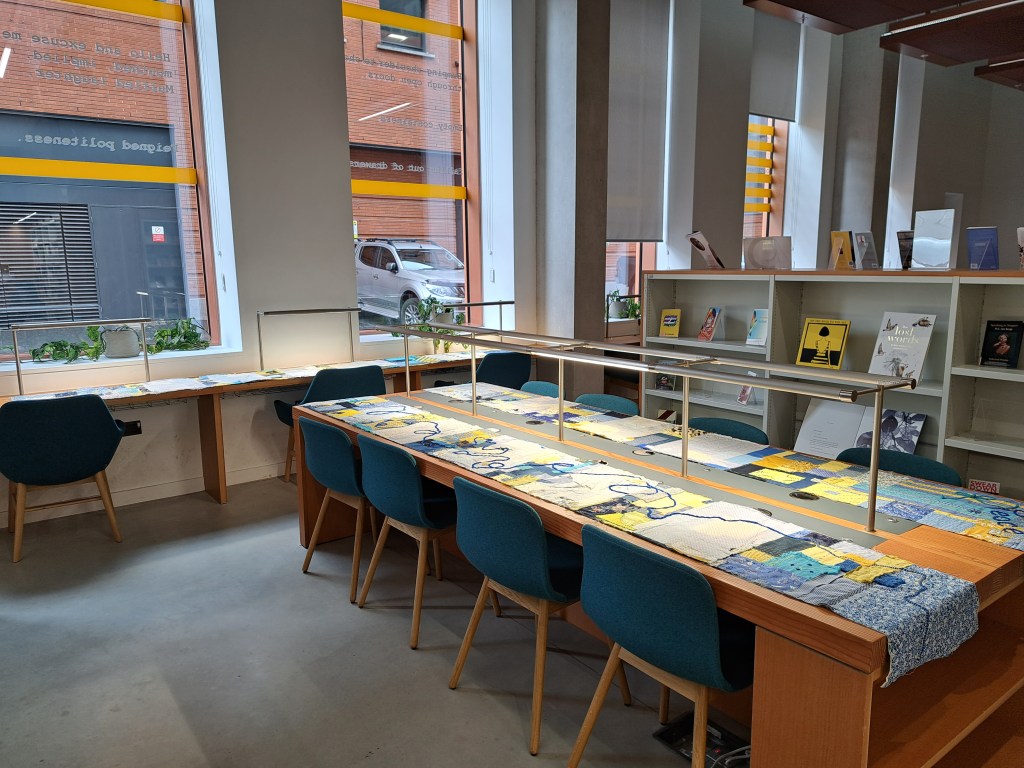
We have planned to run two workshops 10.30 – 12.30 & 1.30 – 3.30 pm for the 5 sessiosn booked in the Poetry Library. Unwittingly we have picked two weeks to begin when the University is quiet due to the Easter break; even the local cafe is closed. However it gave us the chance to set up three of the four border pieces in the Library and test out how to best use the space. There is a large round table in the corner surrounded by two large windows. The light is superb for stitching and the atmosphere calm, one of quiet study although there is an enticing record player and a pile of poetry LP’s alongside. Libby has not seen the border recently and notes it has vastly changed from the first session when everyone madly basted on fabric patches and templates with running stitch.
The library is open to the public although it proves more difficult to get into the building duing the holiday period. We put a sign up in the window overlooking Oxford Road for those passing by, and display one of the border pieces along the window sill. A fellow researcher of stitch, Stewart spends the morning with us. I read from a book of poems I picked up in Northern Ireland in 1998 called ‘Meet me halfway’. It uses poetry to document meetings between two womens’ writing groups from each side of the border and their exchanges of craft, cooking, and writing; breaking down prejudices by getting to know each other. I also read a summary of the life of Americo Paredes, a favourite of mine, he wrote extensively about the Mexican-Texan border and inspired me when he wrote that folklore arises on a border, not necessarily passed down from a distant past. He also sees conflict and disagreement as useful between communities in order to unite against the ruling group. I read a poem of his. Martin Kratz, lead for the Poetry Library stops by to recommend some border readings: ‘Swims’ by Elizabeth Jane Burnett, (‘My girlfriend’s gone to Kacun’ by Legra Inglais Rodriguez, ‘My body has many parts’ by Carlos Verdu – I can’t find references for these yet). Stewart mentions the work of Eileen Harrison – a poet, sound and textile artist in Wales who in one aspect of her work also draws on her experiences of the Troubles in Northern Ireland.
Rose and Rachael from the university marketing team pop by and take a moment to stitch on the border. Paul, a colleague who started his history research phd in my cohort and who I haven’t seen for ages stops by and promises to come next week. Richard and a friend drop in at the end of the session and we make plans for the readings the following week. Richard is wearing jeans that Libby has repaired with Sashiko stitching. His friend is off to the cricket tomorrow and the conversation turns to the health service. They depart for a meal, I head for the 5.30 pm train, arriving home in Herefordshire at 2.07 a.m! There was a broken down freight train on the track at Ludlow, but something is also badly amiss with the rail service’s communication skills. Stoicism is the attitude of most travellers and we are too tired to fuss. I can’t even speak about this journey home until Saturday.
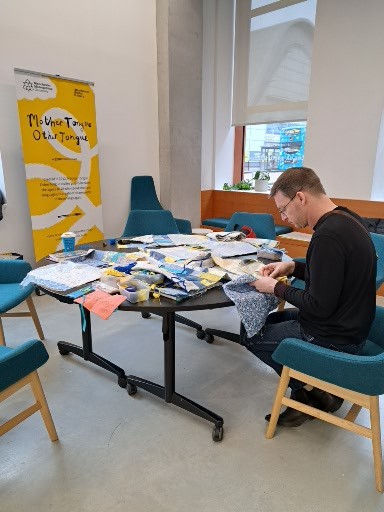
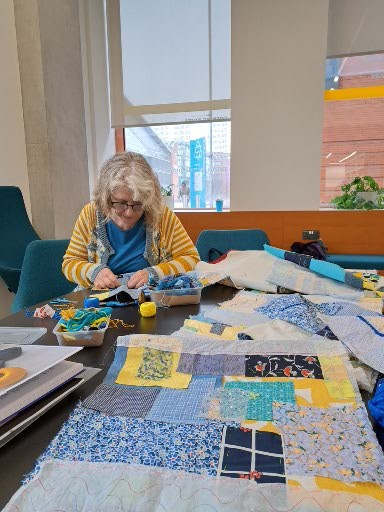


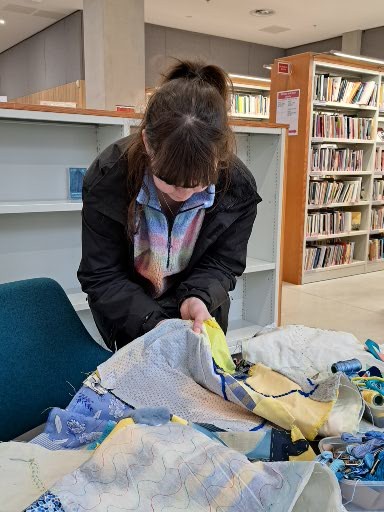

Manchester Poetry Library – 12th April 2023
The second week of the Easter break. Not only is it very quiet on the street, it is raining and overcast. However even whilst setting up I meet Library visitor/ researcher Darryl who tells me of many useful links including the work of poet Kathy Jetn̄il-Kijiner, who writes basket poetry and is a climate change activist based in the Marshall Islands.
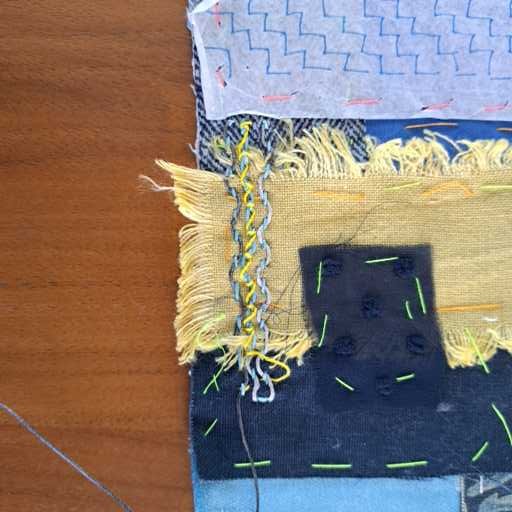
As expected the morning is just us three – Libby, Richard and myself, then three historians arrive at lunch time, including Paul. Talk turns to towns and cities that sit across borders, Stockport and Kansas. Adam is American. Tracey stitches a staircase stitch linking yellow and blue threads and says she will return to finish it. Paul says that the coat of arms for Stockport has a wheatsheaf on it in the colours of the Ukraine flag. I feel we must stitch the wheatsheaf on the border, as Ukraine is sometimes called ‘ The breadbasket of Europe.’
A lecturer pops in and makes an addition. The marketing team return making a film in the library. Their actor joins us to stitch on the border. Two passers by come in from the rain, a mum and her daughter. They are delightful company in spite of their terrible personal losses and NHS work experiences during the pandemic; a turn to embroidery has proven a sooth. Richard reads to us.
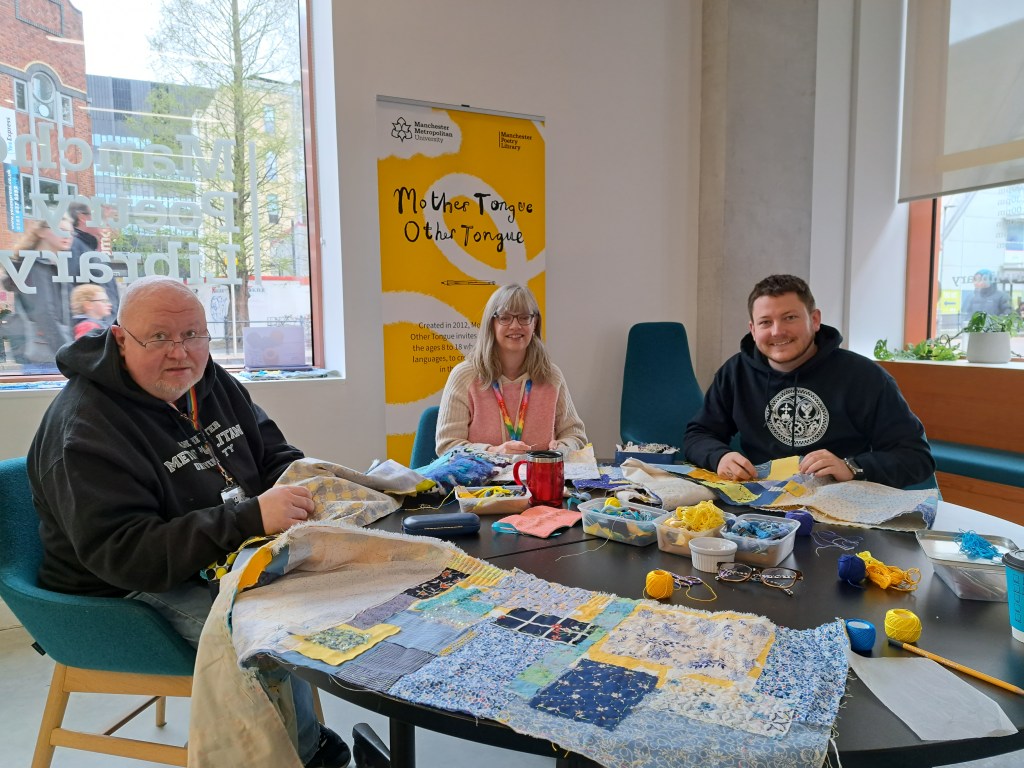

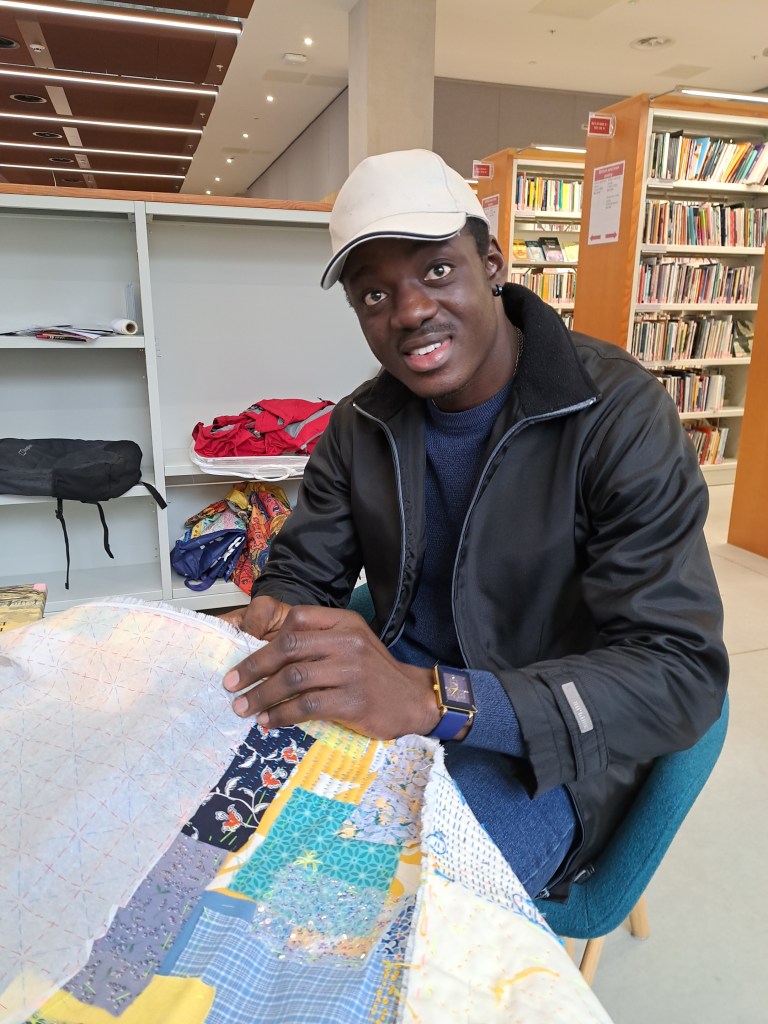
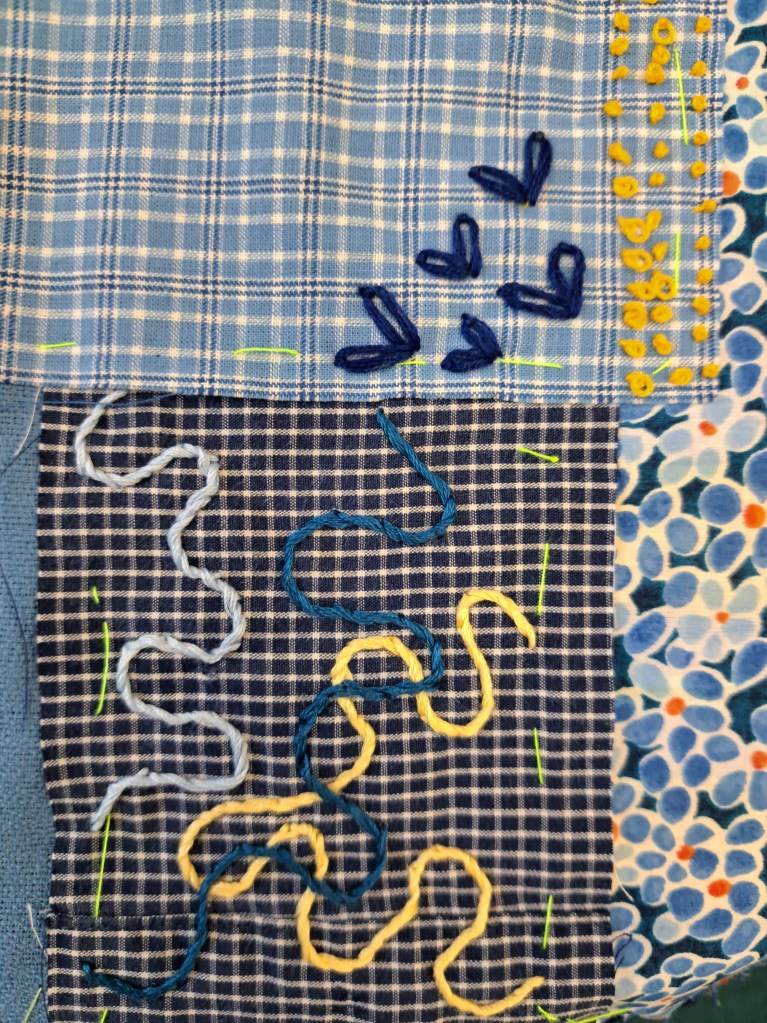
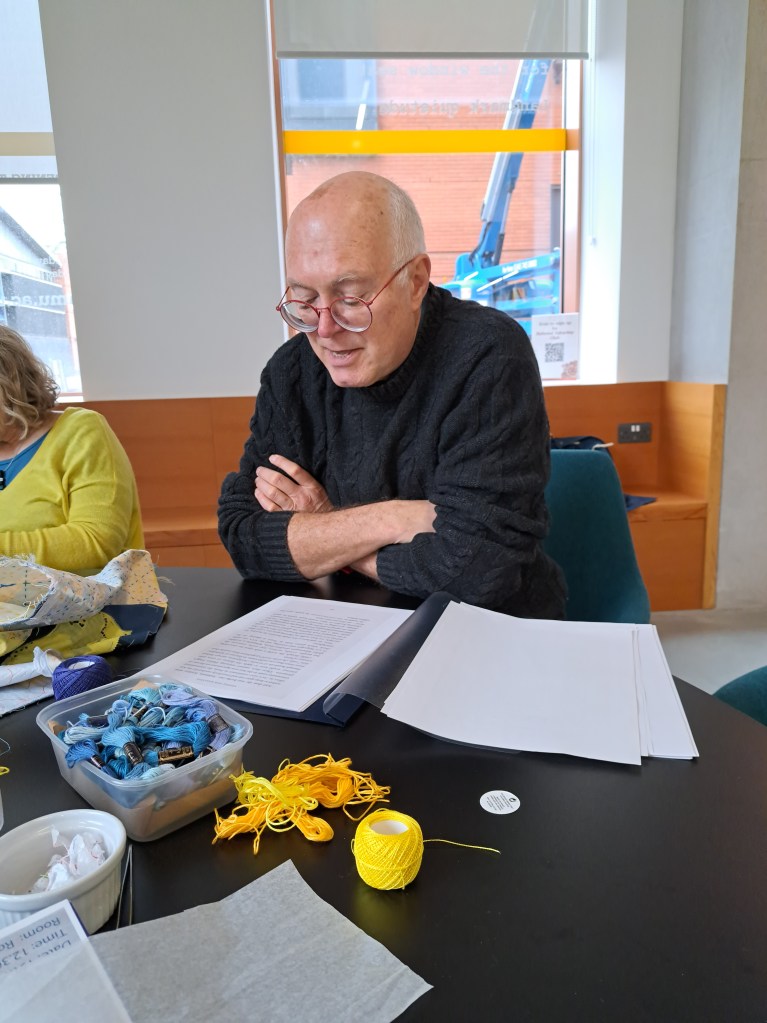
Manchester Poetry Library – 26th April 2023
The university is buzzing again around us. There are four of us holding the session space today, Libby, Richard, myself and Mandy Tolley. Mandy has kindly volunteered to join us for the last three sessions and she persuades many colleagues to come along. She arrives with printed out stitch guides and her wonderful charm and enthusiasm.
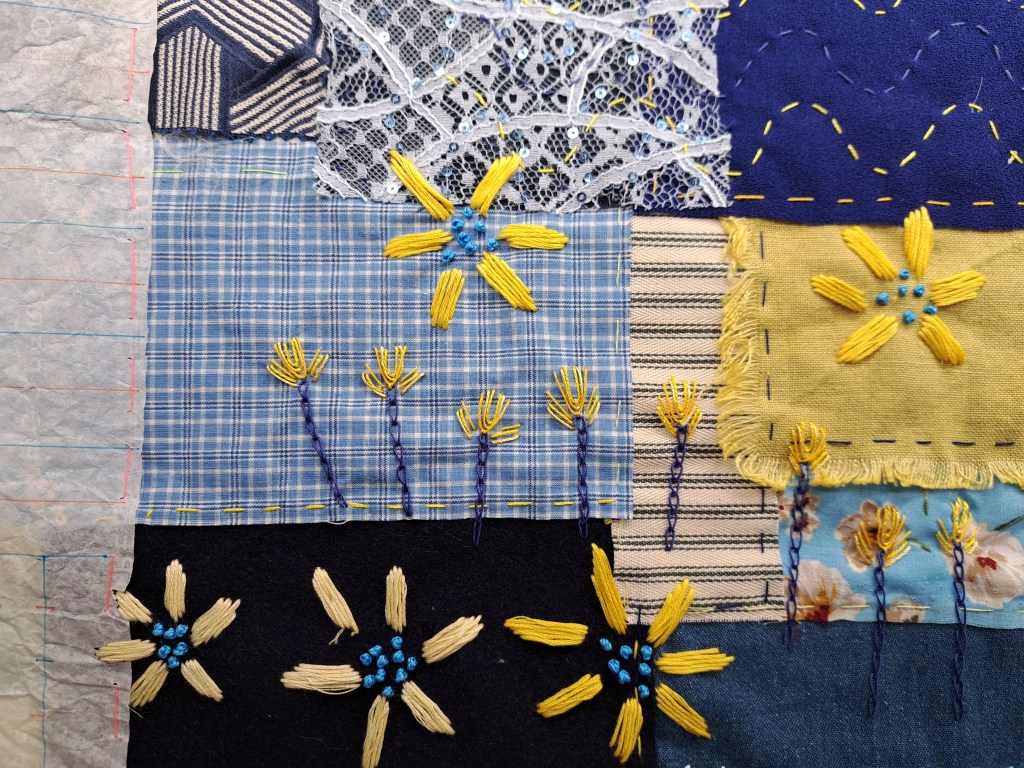
A lecturer stitches whilst her child is read to by her childminder nearby. Today people have travelled from afar to come to the group. It is humbling to have a participant from Ukraine journey into central Manchester especially to join us. A poet from Lancashire arrives. A teacher on vacation from Montreal stops by. My brain tries to recall some French words, but I feel too self-conscious to attempt to speak it in a group. The embroidery skills of the textile professionals are inspiring; the border benefits. Flowers are proliferating.
Richard reads Americo Paredes’ poem ‘No gotta land’, and re-reads the story by the Ukrainian writer about a special pair of gloves, which he had first attempted to read in the first workshop run over the lunchtime intermission nearly a year ago just as people had to leave to go to the afternoon conference session. This time I have time to take in all the details and side stories. I happen to have a much loved pair of gloves in my rucksack purchased 15 years ago from a glove shop on the main square in Sienna where Il Palio is held. I can’t believe I haven’t managed to lose one yet; I relate to the story.
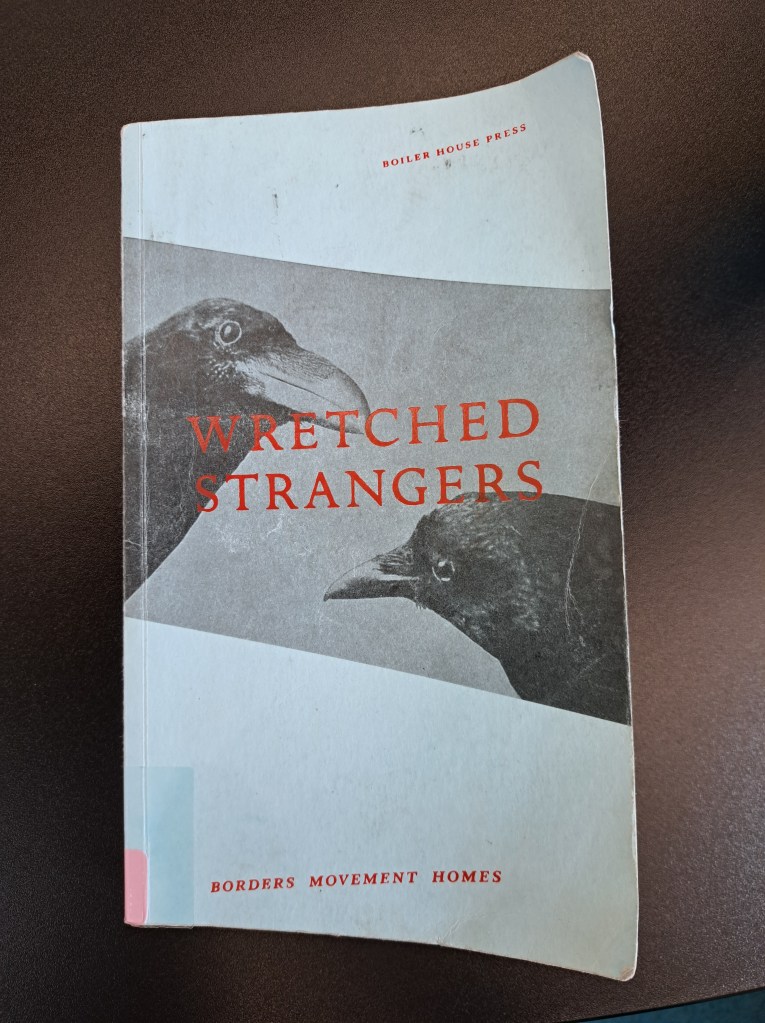
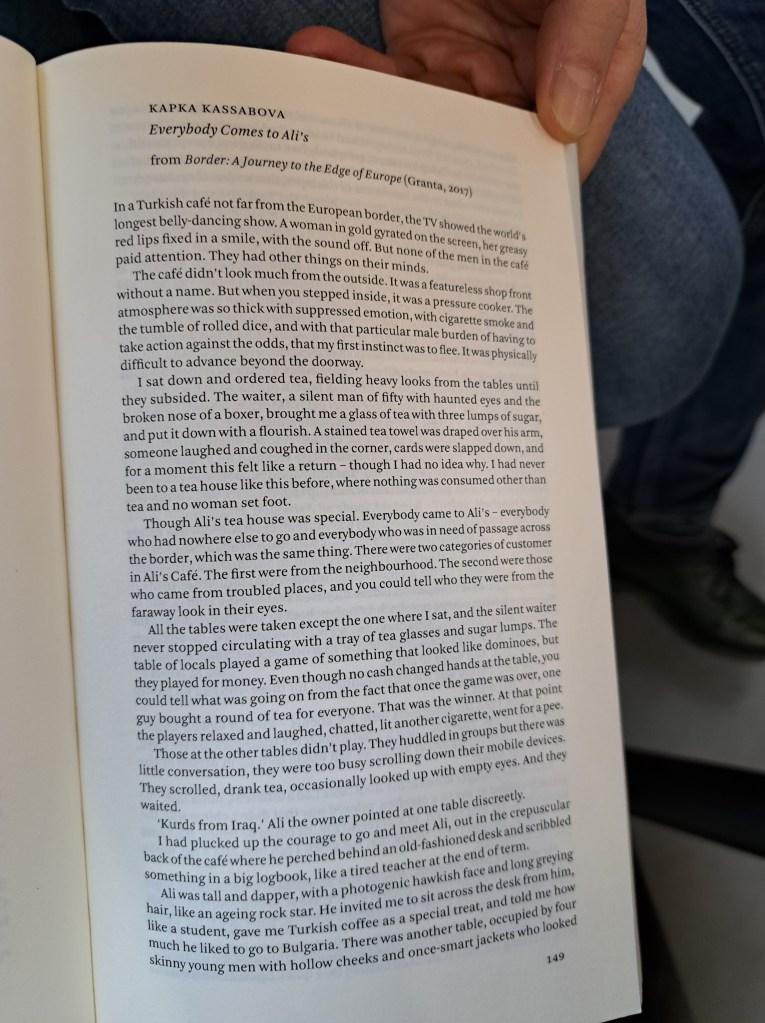
Another reading re-requested, is from ‘Utopia for Realists’; participants write down the reference. It imagines a world without borders and concludes we would all be much richer for it, including financially. In the group we hear more stories of personal struggles post covid; long covid is all around us but sources of help are proving patchy. We search the keyword ‘borders’ on the Poetry Library search engine, many results are found, enough to keep us going for a while. Richard chooses one book ‘Wretched strangers’ and finds it on the shelf; it is a gem.
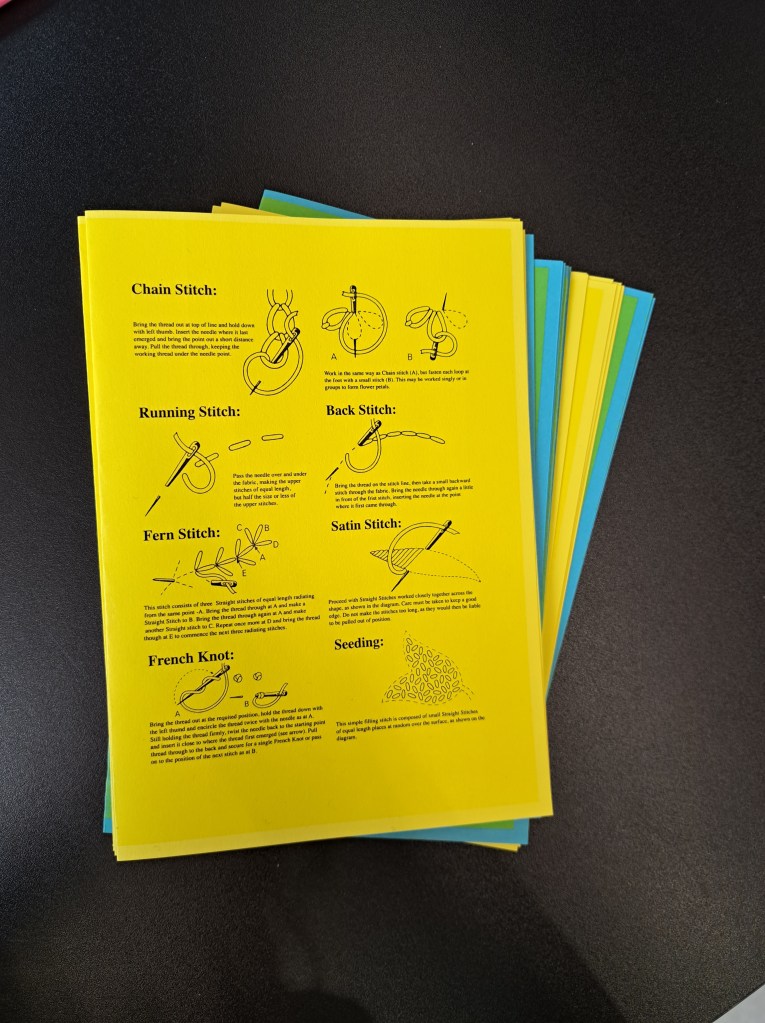


Manchester Poetry Library – 3rd May 2023
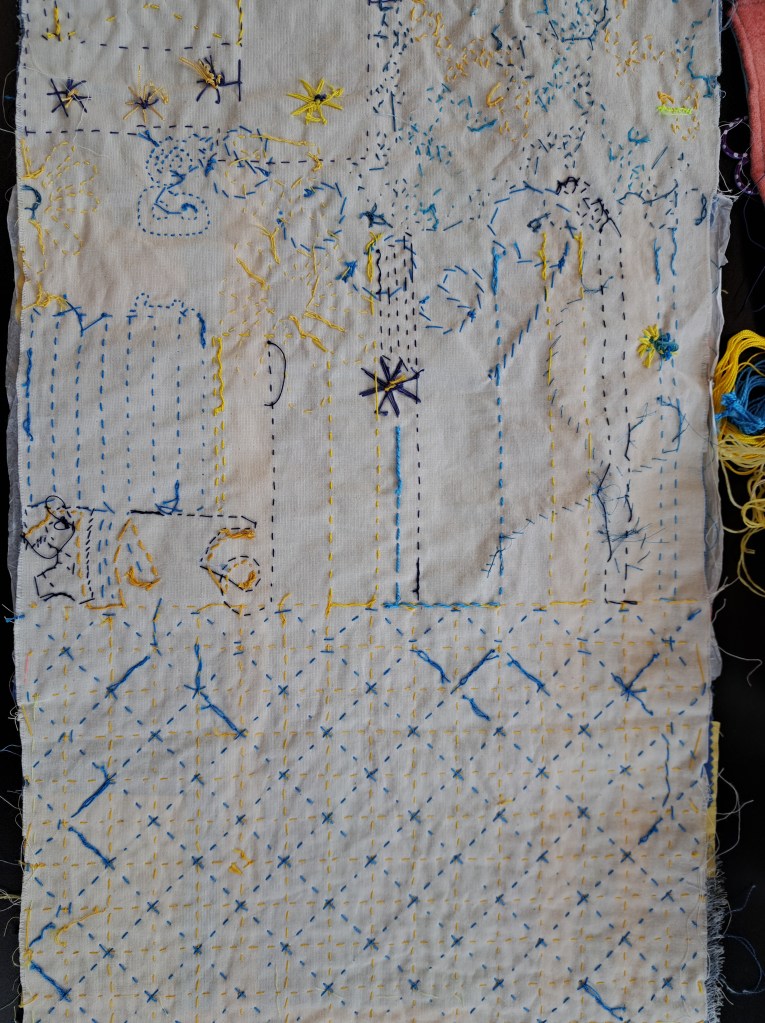
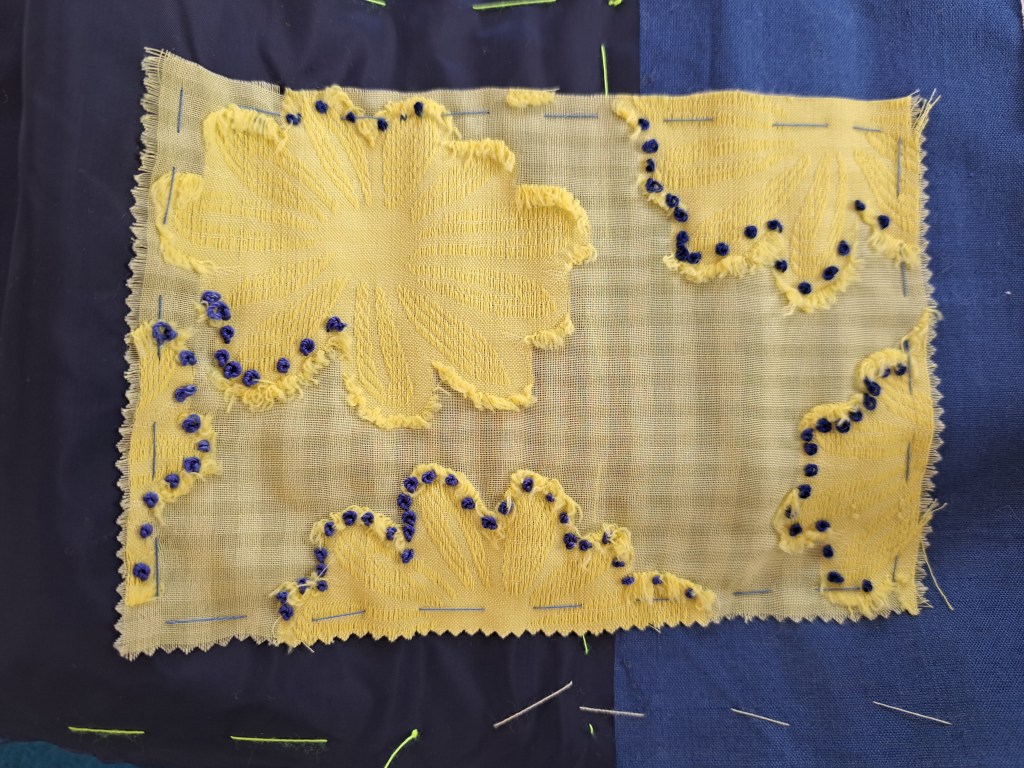
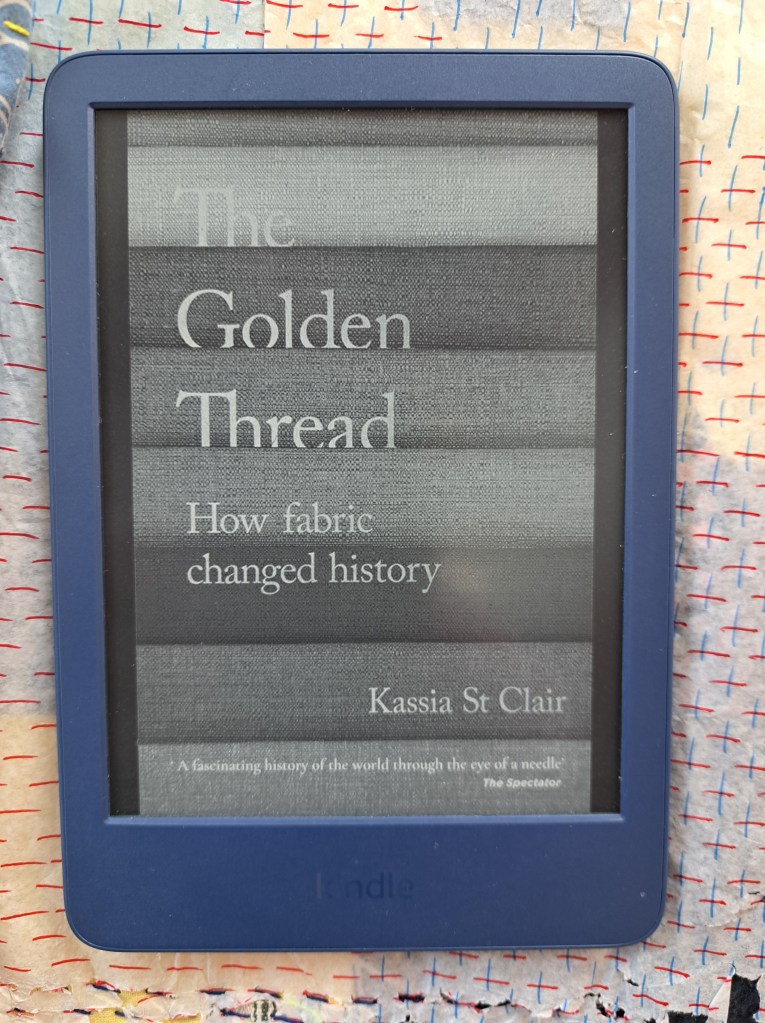
Janey , the Lancashire poet returns bringing readings with her and also showed us a beautiful poem she wrote and stitched Redwork. She read from The Golden Thread by Kassia St Clair, and Threads of Life by Clare Hunter. Emma stitches some morse code and a footprint. Mandy’s textile collegues return in their lunch break. Gemma shows us how to stitch the looped flower, using a pencil to hold the thread in place as it is worked. Laura adds french knots to a delicate fabric making the pattern seem like countries and sea. Joe, a creative writer and fellow collaborator on rivers arrives and reminisces of stitching with his grandmother as he adds to the border.
The border is starting to thicken with all the stitching into it, we also made new connections for places and people it might travel to next. Groups bustle into the Library on tours. I meet Kay Tew who is interested in our project and later puts me in touch with a Ukranian group in Sale.
At the end Adele stops by fresh from an exhibition Green Grads in London where she was interviewed by Kevin Mcloud about her work with textiles and communities to recycle and reuse textiles to reduce the use of oil in its production. Her work sounds fascinating and she stitched a wonderful linking stitch right across the border strip only to have to snip some stitches at the end where it had unwittingly caught another layer of fabric. I like this broken through border, perhaps it will be repaired by another stitcher or left.


Manchester Poetry Library – 10th May 2023
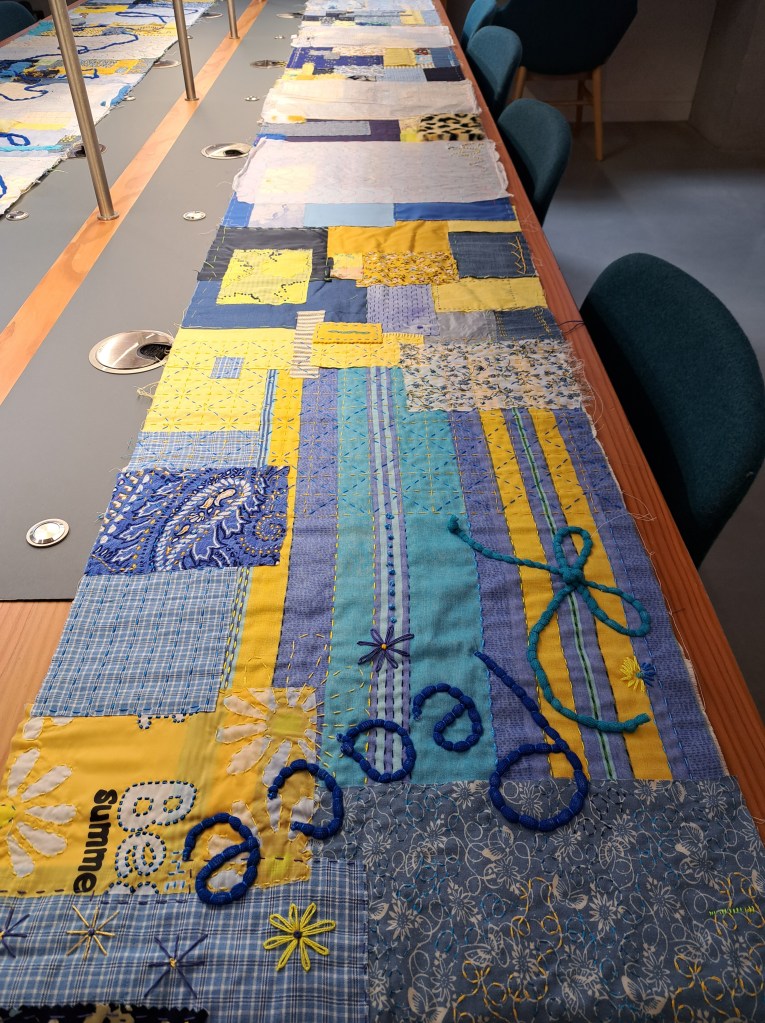
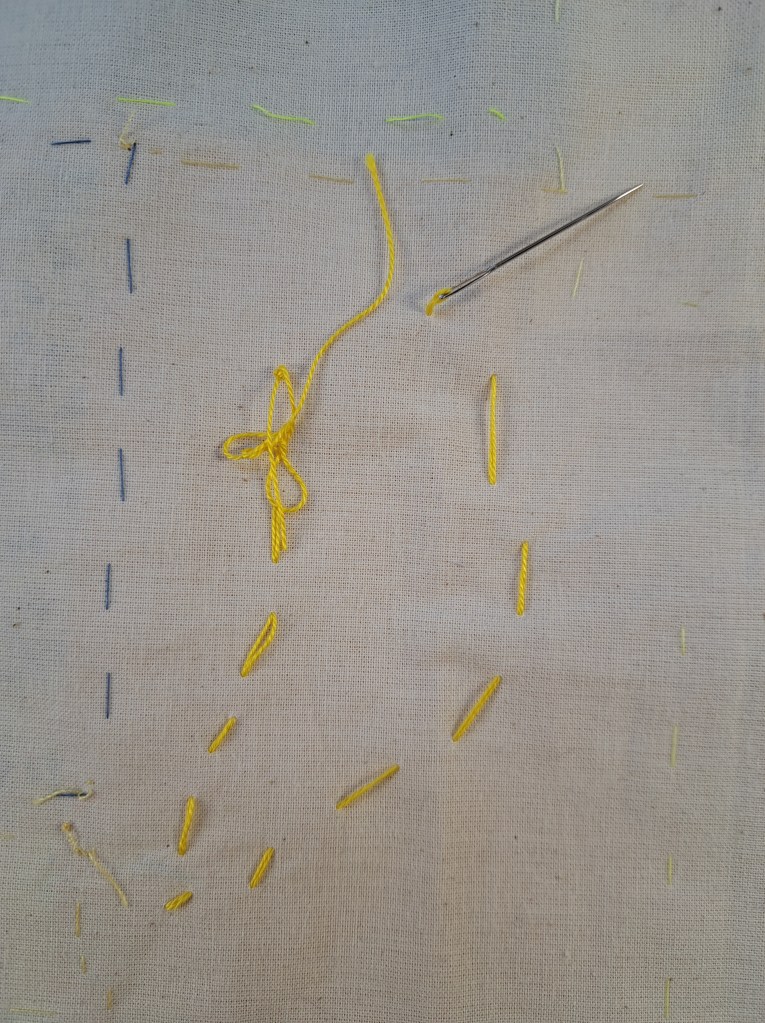
The final session. This week the round table had been put away to make way for an exhibition. However we adapt and the library tables with individual reading lights are perfect for stitching on the border. Despite the glorious space we are just a few stitching today. Mandy masters the wheatsheaf stitch as found on the Embroiderer’s Guild ‘Stitchbank’ webpage. Janey returns to stitch this week rather than read.
Darren drops in, he likes the border project and describes it as ‘sewing the world together… stitch by stitch, person by person’ and also of stitch ‘as a medium of healing’; he is happy for me to reuse his poetic words. He stitches a space that is open, this feels like a way to break borders. He leaves the needle caught having run out of thread to fasten off, it suggests it’s not possible to make a permanent fixing to the ground. I think of border crossings and migration and impermanence, people here in Manchester too, constantly on the move.
I read some more poems from ‘Meet Me halfway’, the book documenting the four exchange meetings between two womens writing groups in Northern Irleand and Ireland. On 10th April it was the 25th Annivesary of the signing of the Good Friday Agreement, also reached in 1998 when this book was published.
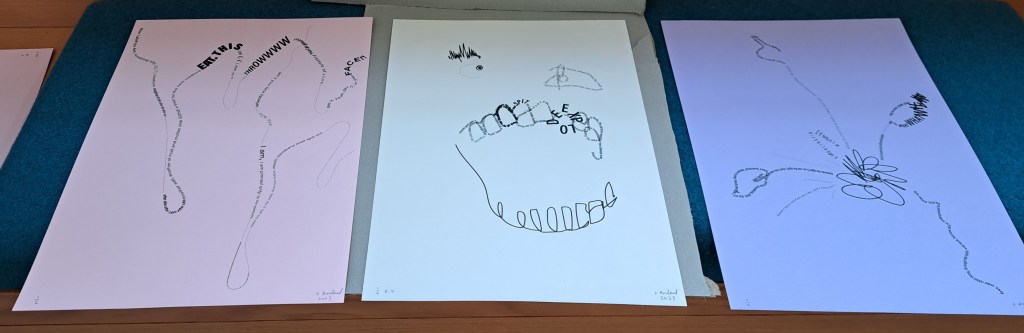
Kate stops by, she is taking a break from working towards her final degree show in Fine Art. A colleague Liv pops in to drop off three prints with me for an upcoming exhibition. They are delicate poem/line drawings, perhaps a form of concrete poetry. Kate helps us decide which order they should be hung in.




After the Poetry Library, where next?
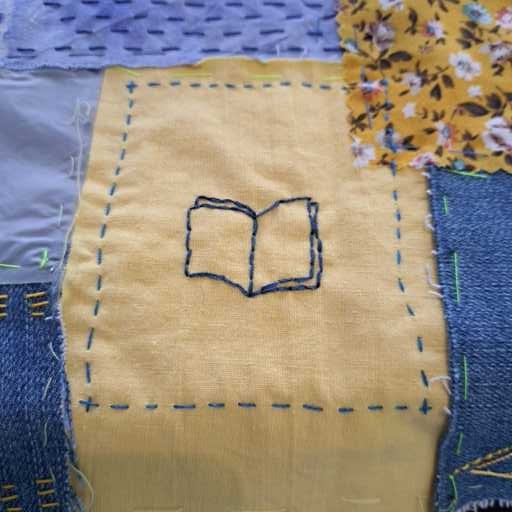
The border needs lots more stitching into although it is starting to have a lovely weighty feel between the hands. We think it would be good to take the border to other groups and are open to invitations! I want to add more wheatsheaf stitches – see Mandy’s examples below.

We have been asked if we might bring the border workshop to a fringe session as part of the Textile and Place conference at Manchester Metropolitan University in October, this will likely be Wednesday 18th October.
Textile and Place 2023 conference at Manchester School of Art
Thank you to Alice Kettle and Gemma Potter for inviting Libby, Richard and I to bring Stitching on the Border to two lunchtime workshops at Textile and Place 2023 conference. Thank you to all those old friends and new who shared a bit of time with us to contemplate all those forced to flee and cross borders. It felt that the two workshops sat well alongside the super presentations and emerging themes. Relly curious this time that we noticed a lot of threads and needles left mid use on the border, left in a hurry or for others to pick up and continue. No time or possibility to fasten off.





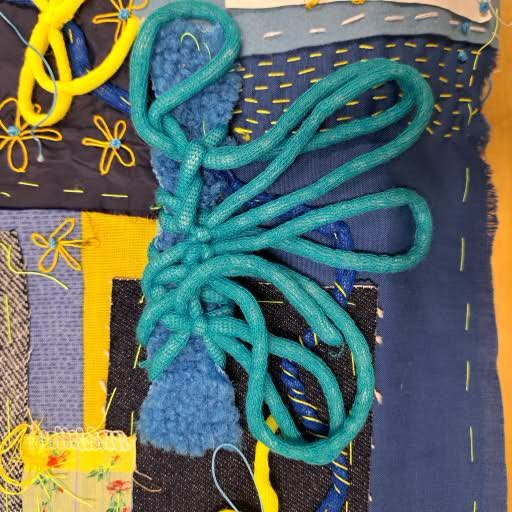

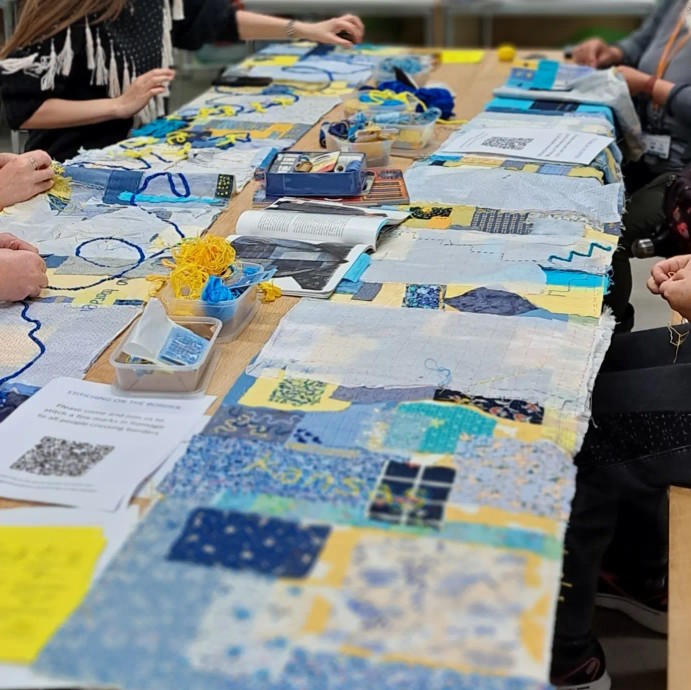
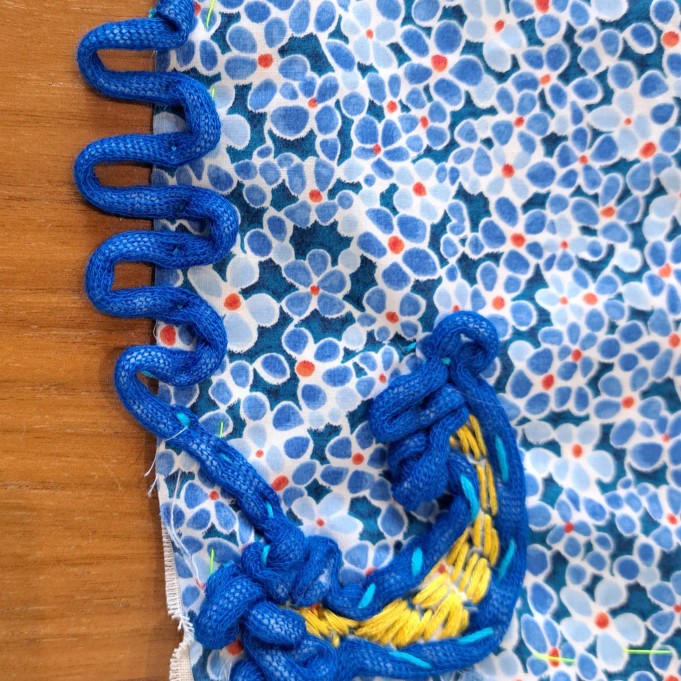
Where next? Libby has taken three of the four border pieces back to Cheshire to work on with some groups around her way.
READINGS
This reading is about crossing the border from Mexico into USA: Cummins J. (2020) ‘American Dirt’. Great Britain: Tinder Press, Headline Publishing Group: pp 324-328.
This reading is about the events that took place in Berlin in November 1989: Levy, P. (2019) ‘The Fall of the Berlin Wall’. Great Britain: Hodder and Stoughton: pp 20-23.
Warning: This reading contains descriptions of extreme violence as it is about the Partition of India in 1947 when thousands died. Khan, V. (2020) ‘ Midnight at Malabar House’. Kindle edition, Great Britain: Hodder and Stoughton: pp 115-117: Location 1757-1785.
This reading is about the existing wall in Cyprus: Charlesworth, E. 92006) ‘Nicosia – reconstruction as resolution’ in Architects without Frontiers. Oxford: Elsevier Ltd: pp 88-89 and pp 91-92.
Reading about possible effects of having open borders: Bregman, R (2018) ‘ Utopia for Realists’. London: Bloomsbury Paperbacks: pp 213-216.
Reading of a short story by a Ukranian author: Zabuzhko, O. (2020) ‘Your Ad Could Go Here’, translated by Halyna Hryn. Seattle: Amazon Crossing: pp 173-181.
Excerpt from Mary Bosworth’s ‘ Border control in an era of mass mobility: Immigration detention in Britain’ in Bordered Lives – Immigration Detention Archive (2019) Berlin: Sternberg Press pp 28
Other possible readings:
Sainz Borgo, K (2019) ‘Scissors’. Translated by Elizabeth Bryer in The Best Short Stories 2021, edited by Chimanda Ngozi Adichie. New Youk: Penguin Random House: pp 86-90.
Swift, J (1727) ‘Holyhead, September 25, 1727’ in Jonathon Swift Selected Poems (1993), edited by Pat Rogers. London: Penguin Group: pp 103.
 The Lugg Embroideries